

You set up the agent on a Sunday night.
By Wednesday, it had sent you four summaries, two of them wrong, and you spent your best morning hour checking its work.
By the second Friday, you stopped opening its output. Nobody turned it off. It just stopped mattering.
If that sounds familiar, the agent was not the problem. The way it was managed was.
The short answer: you manage AI agents the way you manage a good contractor.
Give each one a job description, a schedule and a stop rule, and put the human only where judgment changes the outcome.
The rest of this article is how to do that without turning yourself into a full-time reviewer.
Why do most agent setups quietly die after two weeks?
Most agent setups start as excitement, not as a decision.
Someone sees a demo, connects a few tools and says "let's see what it does". That is a pet project. It has no owner, no definition of done and no date when anyone decides if it worked.
Then three things happen:
- The agent produces more than anyone asked for, so its output becomes a new inbox.
- It runs whenever it likes, often in the middle of your focus block.
- And because nobody agreed what "good" looks like, every output needs a full human check. You save the drafting time and spend it again on reviewing.
That is how AI ends up making people busier instead of lighter, the pattern behind AI brain fry.
The usual advice, "keep a human in the loop", makes it worse when it means humans everywhere, forever.
What is the difference between drain work and judgment work?
Before you manage an agent, decide what it should touch.
In LEAF, the Energy pillar says: manage energy, not time.
Match your hardest work to your peak window and protect the core. Applied to agents, that splits work in two.
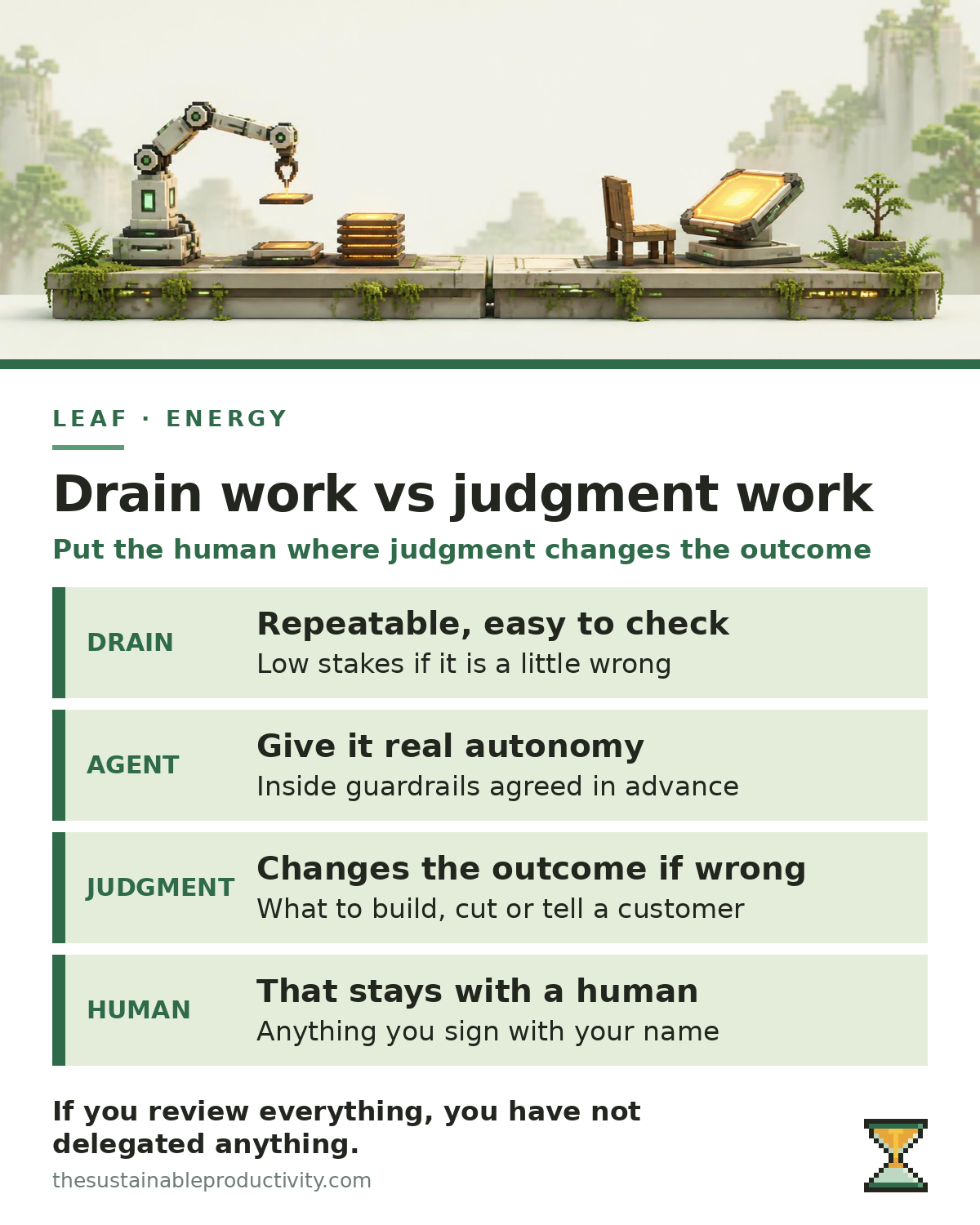
Drain work is repeatable, easy to check and low stakes if it is a little wrong:
- collecting status from five tools,
- first drafts of release notes,
- tagging feedback,
- preparing an agenda.
It costs energy and rarely needs your judgment.
Judgment work changes the outcome if it is wrong:
- what to build next,
- what to tell a customer,
- what to cut,
- anything you sign with your name.
That stays with a human.
The honest version of human in the loop is not humans everywhere.
If you have not decided what to hand over yet, start with what to automate with AI, then come back here.
What does an agent's job description look like?
Write it like you would for a new hire, in five lines:
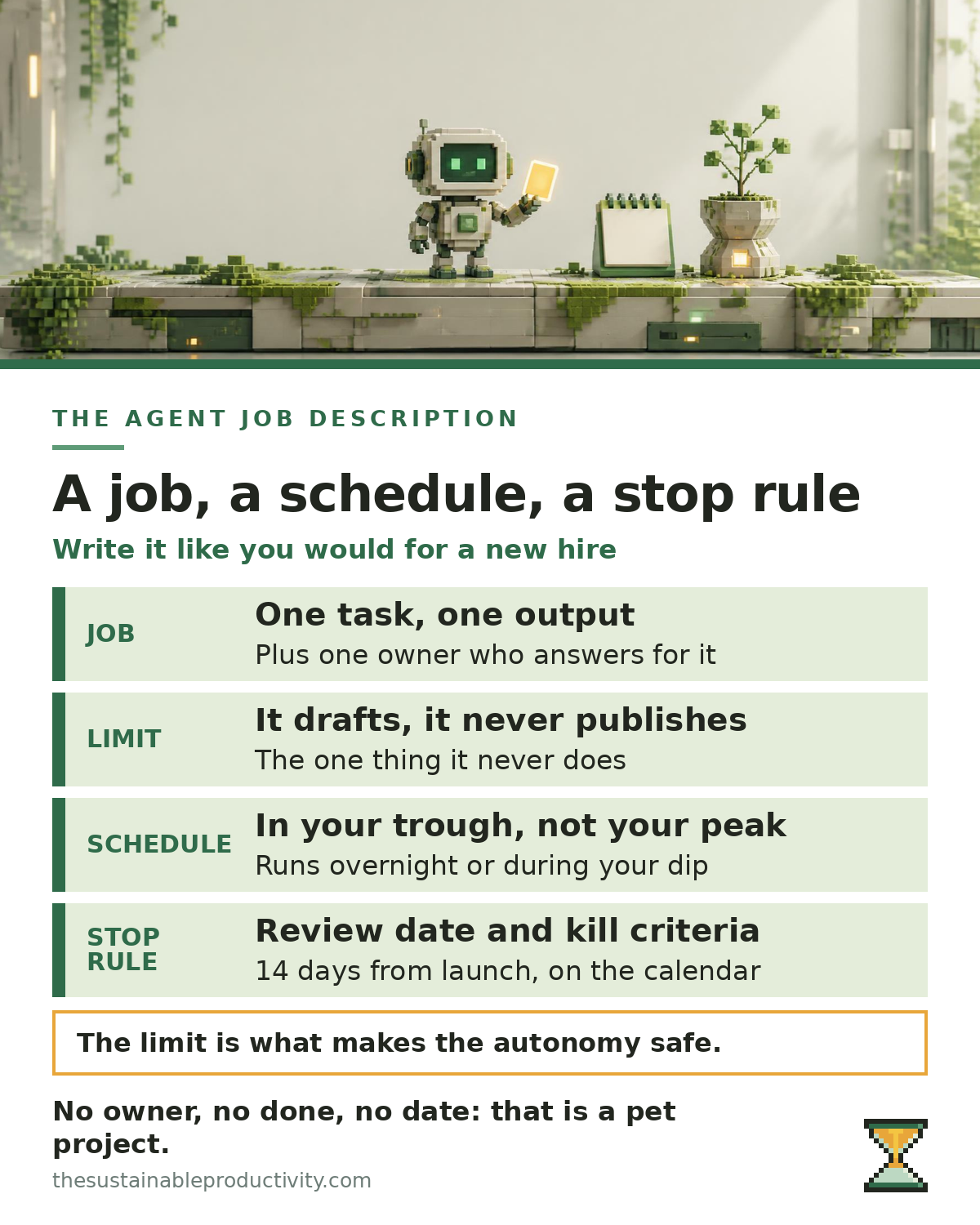
- Job: one task, one output. "Drafts the weekly status from Jira and Slack." Not "helps with project management."
- Owner: the one person who reads the output and answers for it.
- Limit:
- Which tools it can read, and the one thing it never does.
- My recommended limit: it drafts, it never publishes.
- Output: where the result lands and in what shape, so checking it takes minutes, not an hour.
- Schedule and stop rule: when it runs and when you decide if it stays (next two sections).
I run my own blog this way. A scheduled agent drafts the article on Friday evening, writes it into my content board and stops.
It cannot publish, schedule or send anything.
On Saturday I read it, edit it and schedule it myself.
For a team, put these job descriptions in your Team Working Agreement for AI, so everyone knows who owns which agent.
When should an agent run?
In your trough, not your peak.
Daniel Pink, in When (2018), describes a daily pattern most of us share: a peak when focus is sharpest, a trough when it dips, and a recovery after.
Your chronotype shifts the timing, and you can map your own with the chronotype audit.
Agents do not have a trough. You do. So the agent runs overnight or during your dip, and its output waits for a fixed review slot outside your peak.
No pings, no "ready for review" notifications in the middle of deep work.
The review is a short meeting with yourself, on the calendar, at the same time every week.
What is the stop rule?
Every agent gets a review date and kill criteria before it starts. Without them, dead agents keep running, nobody trusts their output and the noise grows.
Keep it simple:
- Review date: 14 days from launch, on the calendar.
- Keep it if checking its output is clearly faster than doing the work, and you used what it produced.
- Kill it if you redo most of its output, you stopped reading it, or it ever crossed its limit.
A clean stop beats a zombie agent that runs forever and quietly erodes trust in every other agent on the team.
How do you run a 14-day agent pilot?
In TSP every method is a hypothesis with a 14-day loop. Run one agent, not five.
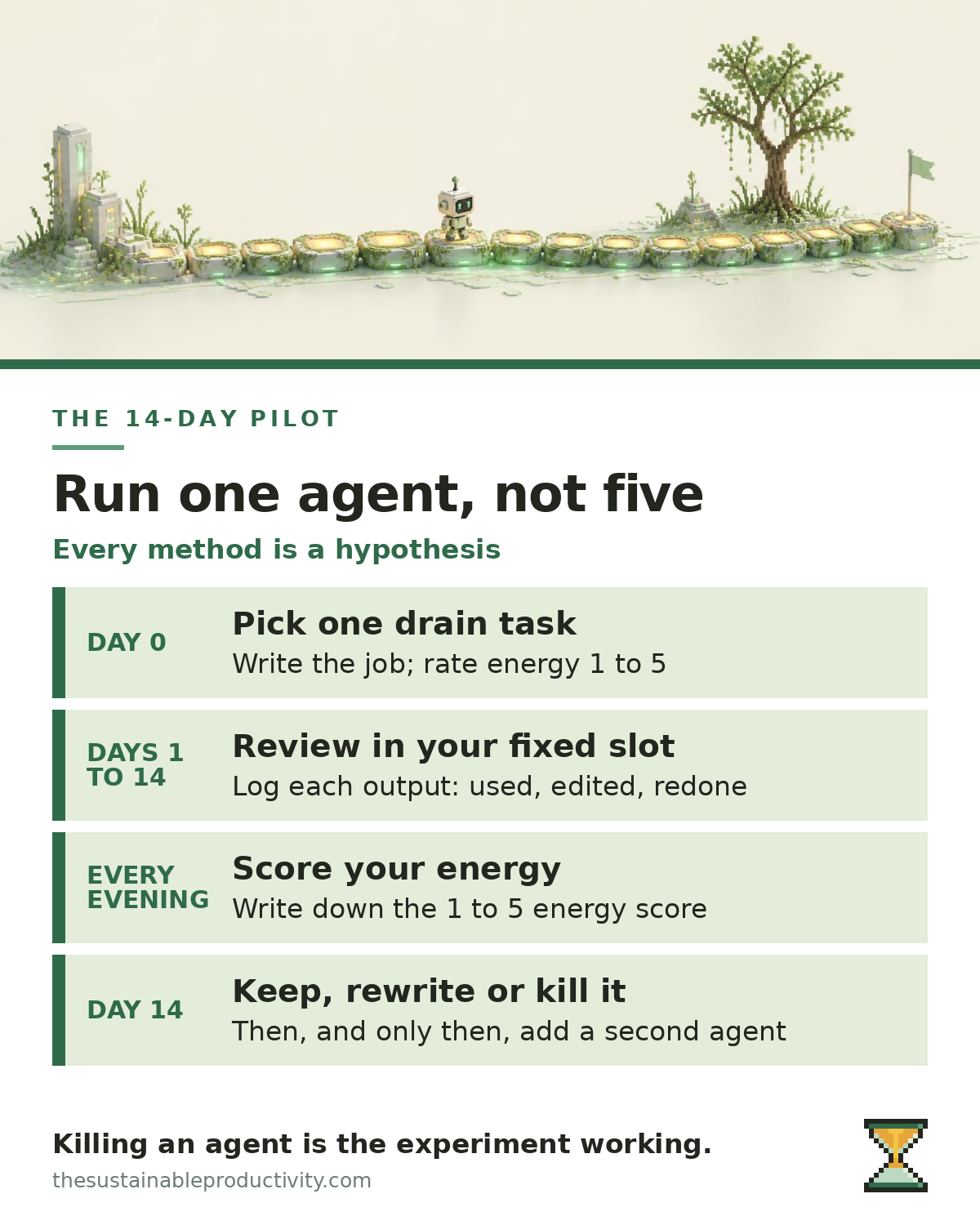
- Day 0
- Pick one drain task.
- Write the five-line job description.
- Note how long the task takes you today and rate your end-of-day energy from 1 to 5.
- Days 1 to 14
- The agent runs on its schedule.
- You review in your fixed slot and log one word per output: used, edited or redone.
- Every evening: write down the 1 to 5 energy score.
- Day 14: compare.
- Keep it, rewrite the job description, or kill it.
- Then, and only then, add a second agent.
What is the point of handing the drain to agents?
Core Value 4: don't break the core.
If your pilot ends with the same late nights and more output to review, it failed the audit, whatever the time savings look like.
Sleep, movement and a real shutdown are not what you trade for velocity. They are what velocity is for.
FAQ: managing AI agents
How much autonomy should an AI agent have?
As much as the task allows, inside one hard limit. Full autonomy on drain work that is easy to check. None on anything that speaks for you or your team in public.
What should always stay with a human?
Decisions you are accountable for: priorities, people, customer commitments and anything published under your name.
How many agents should one person manage?
Start with one. Add the next only after the first one passes its 14-day review.
Is this an argument against AI agents?
No. It is an argument for running them on purpose. TSP is pro-AI and pro-filter.
Your next step: choose one
Leading a team that adds agents faster than it can review them?
Book the free 45-minute flow diagnostic, and we'll map together where the review work piles up.
Your own agents create more to check than they save?
That's what we fix in TSP Premium Mentorship: 12 weeks of 1:1 work on your real context and your real bottlenecks.
Grow your work. Don't grind it. The full system lives in The Sustainable Productivity Method Online Course.