
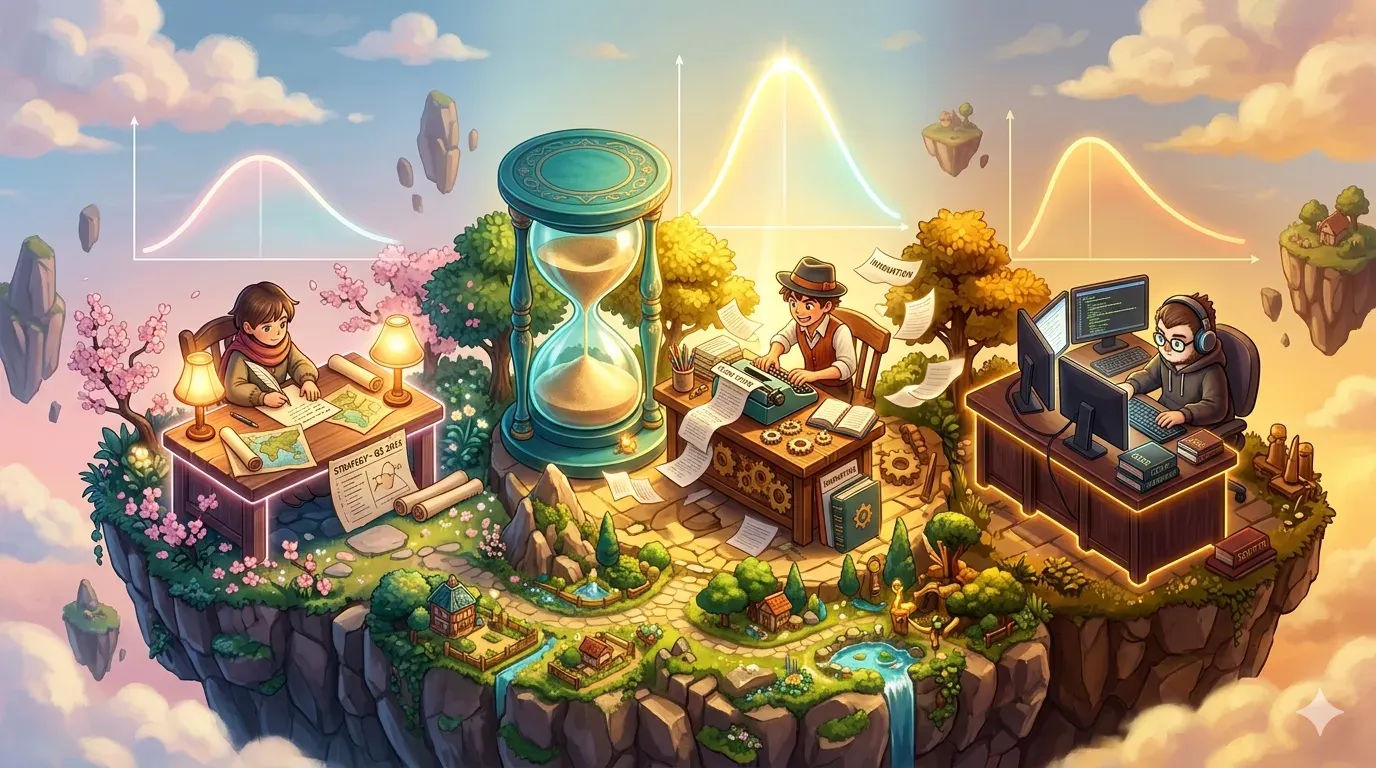
You’ve been told to wake up at 5am.
You’ve been told that’s when the “successful people” do their best work. You’ve read the books, watched the YouTube videos, maybe even bought the sunrise alarm clock.
And then you sat there at 5:15am, staring at a blank document, wondering what’s wrong with you.
Here’s the truth: nothing is wrong with you. You were just given advice written for a completely different species.
TL;DR / Key Takeaways
- 65% of people are “Third Birds” whose peak cognitive window sits around mid-morning, not dawn;
- Daniel Pink’s research in “When” maps three chronotypes (Larks, Third Birds, Owls) with distinct daily performance shapes;
- Scheduling deep work outside your peak window is a biological tax you pay every single day;
- The F.A.K.E. Framework’s “E” (Energy) is useless without knowing WHEN your energy actually peaks;
- A free-day sleep midpoint test reveals your chronotype in under 5 minutes.
The 5am Club Was Built for 14% of the Population
The uncomfortable truth: roughly 14% of people are natural “Larks” who peak in early morning. The other 86% are getting productivity advice designed for a minority.¹
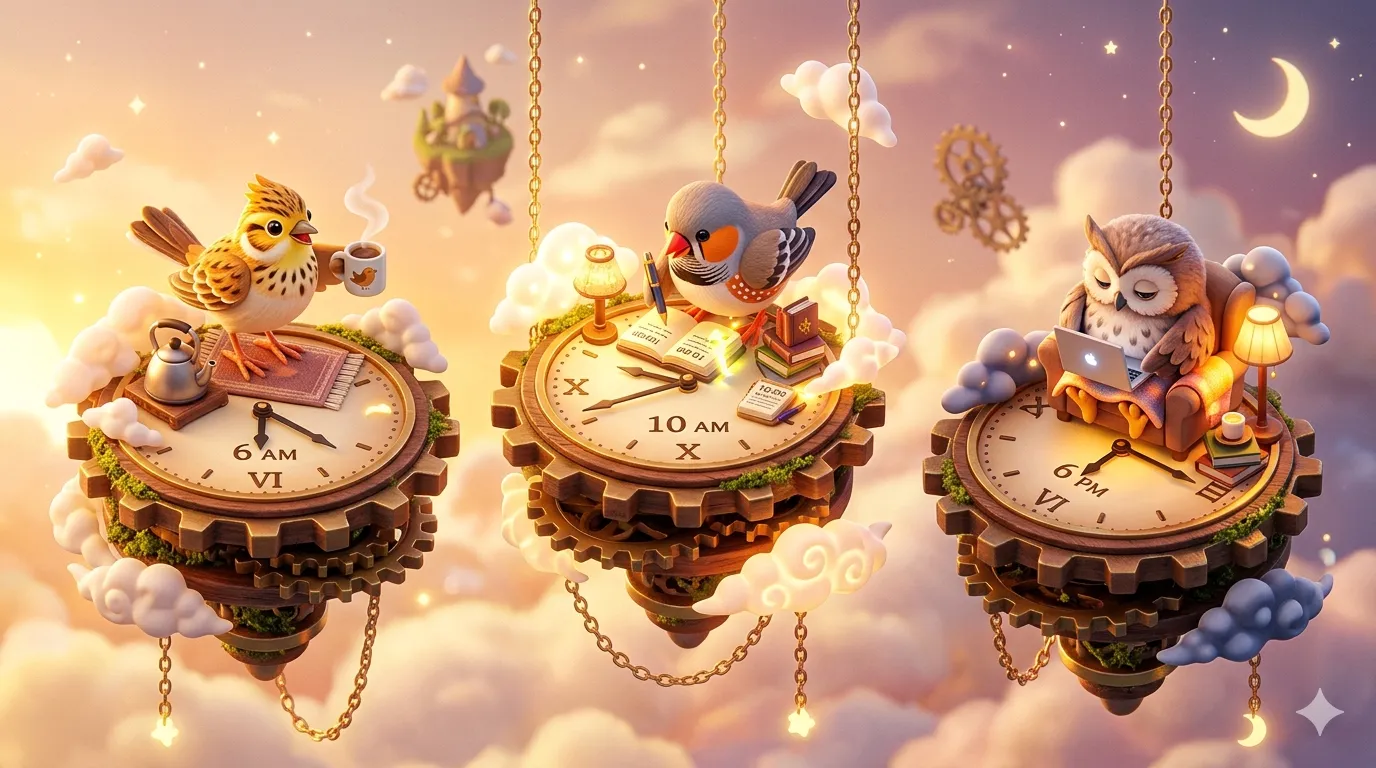
Daniel Pink’s research in When: The Scientific Secrets of Perfect Timing breaks the population into three chronotypes:
- Larks (14%): natural early risers, peak cognitive window in mid-to-late morning.
- Third Birds (65%): the majority, peak window around midday or late morning.
- Owls (21%): late-day performers, peak window in late afternoon or evening.
The problem? Almost every productivity guru you follow is a Lark.
Or, they became one by discipline and survivorship bias.
And they’re writing books, building courses, and running podcasts about their experience as if it applies universally.
It doesn’t.
Your Brain Has a Shape. Here’s What It Looks Like.
Every chronotype follows the same three-stage daily performance arc: Peak, Trough, and Rebound.
The difference is the order and timing of those stages.¹
For Larks and Third Birds, the shape runs like this:
- Peak: analytical thinking, focus, hard decisions.
- Trough: low vigilance, slower processing, high error rate.
- Rebound: creative thinking, looser associations, brainstorming.
For Owls, the order reverses: Rebound first, then Trough, then Peak.
This matters enormously. Your brain in the Trough is genuinely worse at cognitive tasks.
Pink’s research documents measurable drops in logical reasoning and error detection during the afternoon trough window.
This is not a motivation problem. This is neurobiology.
How to Find Your Chronotype in 5 Minutes (The Free-Day Test)
The most reliable way to identify your chronotype is to find your sleep midpoint on a free day when you have no alarm set and no obligations.
Here’s the protocol Pink describes in When:¹
- Pick two consecutive free days (a weekend or holiday works perfectly);
- Let yourself fall asleep naturally, with no alarm;
- Note the time you fell asleep and the time you woke up;
- Find the midpoint.
If your midpoint falls before 3:30am (e.g., sleep 10:00 p.m. – 6:00 a.m., midpoint 2:00 a.m.), you’re likely a Lark.
If it falls between 3:30am and 5:30am, you’re likely a Third Bird (approx. 60–80% of population).
If it falls after 5:30am (e.g., sleep 1:00 a.m. – 9:00 a.m., midpoint 5:00 a.m.), you’re likely an Owl.
That’s it. No app required. No personality quiz. Just biology.
Your Applied Schedule, By Chronotype
If You’re a Lark 🌅
- Deep work: 8:00 to 10:30am. Strategy, writing, architecture, complex decisions go here.
- Meetings and collaboration: 11am to 1pm. You’re past peak but still coherent.
- Admin, email, low-stakes tasks: 2:00 to 4:00pm. Trough time. Perfect for the stuff that doesn’t need your full brain.
- Creative work: 4:30 to 6:00pm. Your Rebound window. Looser thinking, better for ideation.
Stop scheduling deep work after lunch. That window is biologically spent.
If You’re a Third Bird 🐦
(This is ~65% of you. Read carefully.)
- Deep work: 10:00am to 12:30pm. This is your most expensive real estate. Sell nothing here.
- Collaborative meetings: 1:00 to 2:00pm. Light cognitive load while you’re in early Trough.
- Admin and email: 2:00 to 4:00pm. Batch everything mindless here. Trough is designed for this.
- Creative and ideation: 5:00 to 7:00pm. Your Rebound kicks in. Brainstorm, sketch, experiment.
If You’re an Owl 🦉
- Light tasks and warm-up: 9:00 to 11:00am. You’re in Rebound. Creative, but not analytical. Use it for brainstorming, not decisions.
- Trough: 12:00 to 3:00pm. This is your hardest window. Protect yourself. Don’t book anything important here.
- Deep work: 3:00 to 7:00pm. This is your Peak. Defend it like a contract.
The 9am all-hands meeting is a biological tax on Owls. And it’s scheduled by Larks.

The Hybrid-Work Trap: 9am Meetings as a Biological Tax
The modern hybrid calendar steals from the wrong window almost by default.
Microsoft’s 2025 Work Trend Index reports that 50% of meetings are scheduled between 9am and 11am, or 1pm and 3pm. ³
For Third Birds and Owls, that’s either your Peak window or your guaranteed Trough.
Neither is ideal for a status update that could have been a Slack/Teams message.
The workplace default was built for Larks by Larks.
The 9-to-5 structure, the morning stand-up, the early all-hands: these are not neutral choices.
They are biological assumptions baked into calendar infrastructure.
For hybrid and remote workers who have more schedule autonomy than office workers, this is actually good news.
You have the rare ability to engineer your calendar around your biology. Most people don’t use it.
The ones who do? They consistently outperform their always-on, always-available counterparts.
Not because they work more. Because they work aligned.
The 14-Day TSP Chronotype Experiment
This is TSP Core Value 2 in action: Scientific Experimentation 🧪
Don’t take my word for it. Test it.
Week 1: Identify and Observe
- Day 1: Take the free-day sleep midpoint test (see above).
- Days 2 to 7: Track your energy on a 1 to 10 scale at 9am, 12pm, 3pm, and 6pm. Just a number in a notes app or paper. Two minutes per day.
Week 2: Apply and Measure
- Day 8: Map your chronotype schedule using the framework above.
- Days 9 to 14: Block your peak window as immovable. Deep work only. No meetings. No exceptions.
- Day 14: Compare output quality and energy scores from Week 1 to Week 2.
Most people notice the difference by Day 10.
A few push back on Week 2’s data by Day 14.
That’s Core Value 3: Reflect and Adapt.² The experiment updates the plan.
How Chronotype Connects to the F.A.K.E. Framework
The F.A.K.E. Framework has four filters: Focus, Alignment, Knowledge, and Energy.
The “E” is the one most people skip.
Energy is not just “do I feel tired right now?”. It is a scheduling question.
It is: do I have the right KIND of energy for this task, at this moment?
Analytical tasks (code review, strategic writing, complex decisions) require Peak energy.
Creative tasks (brainstorming, ideation, loose connections) thrive in Rebound.
Administrative work (email, scheduling, routine updates) belongs in the Trough.
When you assign a deep work task to your Trough window, you are failing the Energy filter before you even start.
The F.A.K.E. Framework is not just what to work on. It is when to work on it.
You can learn more about the full F.A.K.E. Framework here.
Don’t Schedule Your Day. Schedule Your Chronotype.
The 5am club works for the 5am people. Let them have it.
You are not a productivity failure for needing to work at 10am or 4pm.
You are a biological entity with a specific performance curve.
The only question worth asking is whether your calendar is aligned with that curve or fighting against it.
Most calendars are fighting. The audit fixes that.
Run the 14-day experiment. Find your midpoint. Protect your peak. Report back.
If you want the full system, including the F.A.K.E. audit, the weekly rebuild template, and the energy tracking worksheet, they’re all inside the Productivity Nirvana Community. Free to join. No spam, no upsell.
Start with the experiment. The rest follows.
This article is a co-creation of Erick Stoic with Claude (Anthropic) and Nano Banana 🍌.
Recommended Reading
The F.A.K.E. Framework: A Human Alternative to SMART Goals for 2026
The full breakdown of TSP’s four-filter system for task prioritisation. Start here if you haven’t already.
FAQ
What is a chronotype?
A chronotype is your biological preference for sleeping, waking, and peak cognitive performance at specific times of day.
It is largely genetic and relatively stable throughout adult life.
The three main types are Larks (early risers), Third Birds (midday performers), and Owls (late-day performers).
What is the sleep midpoint test for chronotypes?
The sleep midpoint test involves tracking your natural sleep and wake times over two consecutive free days with no alarm.
The midpoint between when you fall asleep and when you wake up reveals your chronotype: before 3:30am is Lark, 3:30am to 5:30am is Third Bird, after 5:30am is Owl (details above).
Why do 9am meetings hurt productivity?
For Third Birds (~65% of workers) and Owls (~21%), the 9am slot falls either at peak cognitive time (which should be reserved for deep work) or at the beginning of their day before they have reached their performance peak.
Scheduling meetings during peak windows reduces cognitive output for the rest of the day.
How does chronotype connect to the F.A.K.E. Framework?
The Energy pillar of the F.A.K.E. Framework is not just about whether you feel tired.
It requires matching the cognitive demand of a task to the right energy window in your day.
Analytical tasks belong in Peak.
Creative work belongs in Rebound. Admin belongs in Trough.
Without knowing your chronotype, the Energy filter is incomplete.
Can you change your chronotype?
Chronotypes are primarily genetic and tend to shift only gradually with age (most people move slightly earlier as they get older).
While sleep hygiene and light exposure can influence your schedule, forcing yourself to perform against your biological chronotype consistently leads to sleep debt and cognitive underperformance.
The better approach is to align your schedule to your biology.
References & Further Reading
¹ Pink, Daniel H. When: The Scientific Secrets of Perfect Timing. Riverhead Books, 2018. https://www.danpink.com/books/when/
² TSP Core Values Reference. The Sustainable Productivity Method: 4 Core Values. Erick Stoic, thesustainableproductivity.com, 2026. https://thesustainableproductivity.com/
³ Microsoft. 2025 Work Trend Index: The Human and Agent at Work. Microsoft Corporation, 2025. https://news.microsoft.com/annual-work-trend-index-2025/