
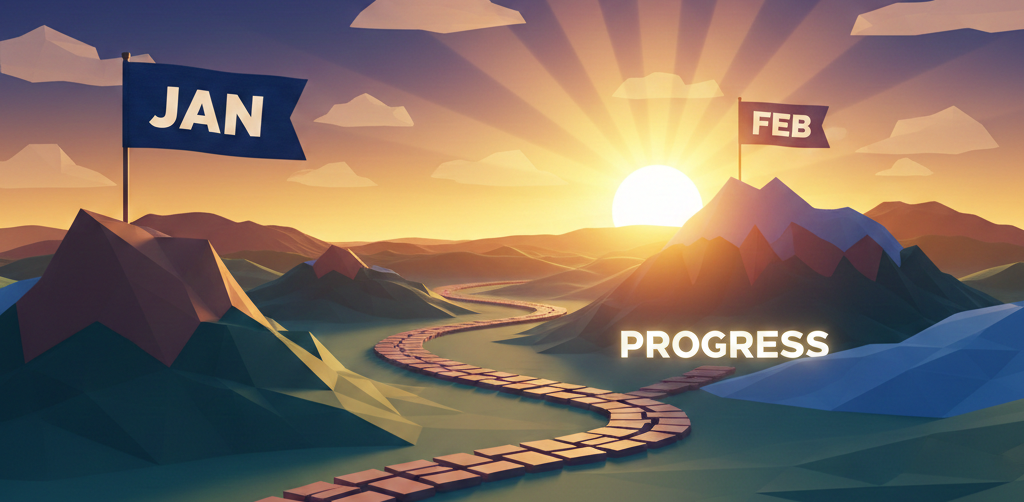
It is January 31st.
Right now, millions of people are doing one of two things:
- Giving up on their New Year’s Resolutions because they “already failed”.
- Doubling down and blindly setting even more aggressive goals for February, hoping that “this time will be different”.
Both approaches are wrong.
As the master Albert said: “Insanity is doing the same thing over and over and expecting different results.”
If you struggled in January, it wasn’t because you are “lazy” or “broken”. It was because your system had bugs. If you don’t pause to debug the code, you are just going to crash again in February.
To build Sustainable Productivity, you need to treat your life like a software product. You don’t need more hope; you need a Retrospective.
⚡ TL;DR: Key Takeaways
- Cognitive Debt: Carrying unfinished tasks and guilt into a new month acts like “background processes” slowing down your brain.
- System vs. Self: Stop blaming your character for failures that are actually caused by poor scheduling or biology.
- The Agile Reset: Use the Start / Stop / Continue framework to ruthlessly prune habits that don’t serve you.
- Iteration > Perfection: The goal isn’t to be perfect in February. The goal is to be better than January.
The “Zombie Project” Trap (The Cost of Open Loops)
Why do you feel tired even before February starts?
Psychologists call it the Zeigarnik Effect: The brain remembers incomplete tasks better than completed ones. 1
Every email you didn’t reply to is an Open Loop. Every workout you skipped is an Open Loop. Every “I should have done that” thought is an Open Loop.
These loops act like “Zombie Projects”, they aren’t alive, but they aren’t dead. They just wander around your subconscious, eating your brains (or specifically, your glucose).
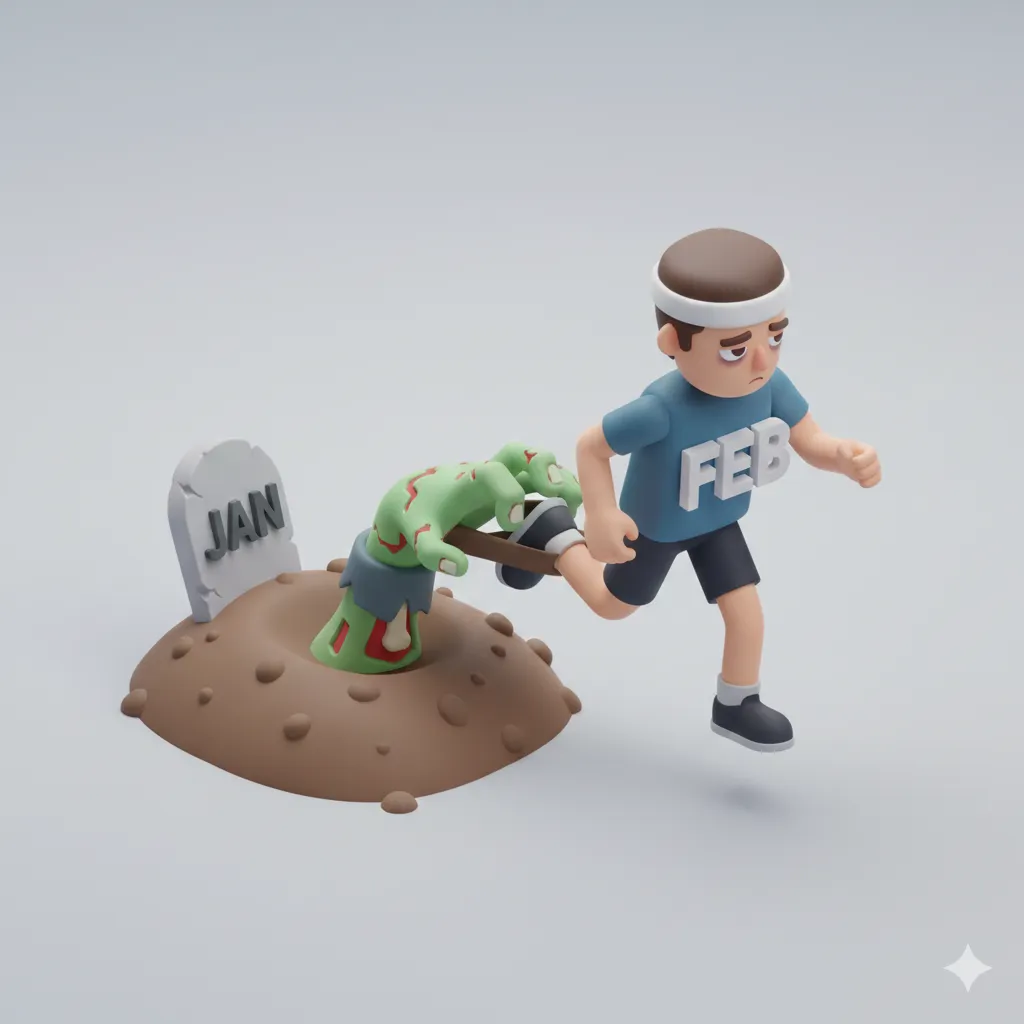
If you don’t “close” January, mentally and logistically, you start February with 50% battery.
As we discussed the Shutdown Ritual in this article, you must signal to your nervous system that the “hunt” is over. You cannot sprint if you are dragging a corpse. 2
The Agile Retrospective: Debugging Your Life
In software engineering, when a work cycle finish (e.g. two weeks of work, delivery a product/project slice), the team do a Retrospective.
We ask in the context of the processes we need to follow, the tools and relationships with other teams/stakeholders/suppliers:
- “What do we need to stop doing?“
- “What do we need to continue doing?“
- “What do we need to start doing?“
We need to apply this engineering compassion to our own lives.
Instead of saying, “I didn’t write my book because I’m lazy“, look at the data.
- Did you try to write at 6:00 PM when your kids were screaming? (That’s a scheduling bug).
- Did you try to write for 4 hours straight without training your focus muscles? (That’s a capacity bug).
As we explored in The Neuro-Productivity Manifesto, your biology has limits. A Retrospective allows you to adjust your plan to fit your biology, rather than fighting it. 3
The Protocol: Start / Stop / Continue
Grab a pen. This takes 10 minutes. We are going to run a classic Agile review on your January.
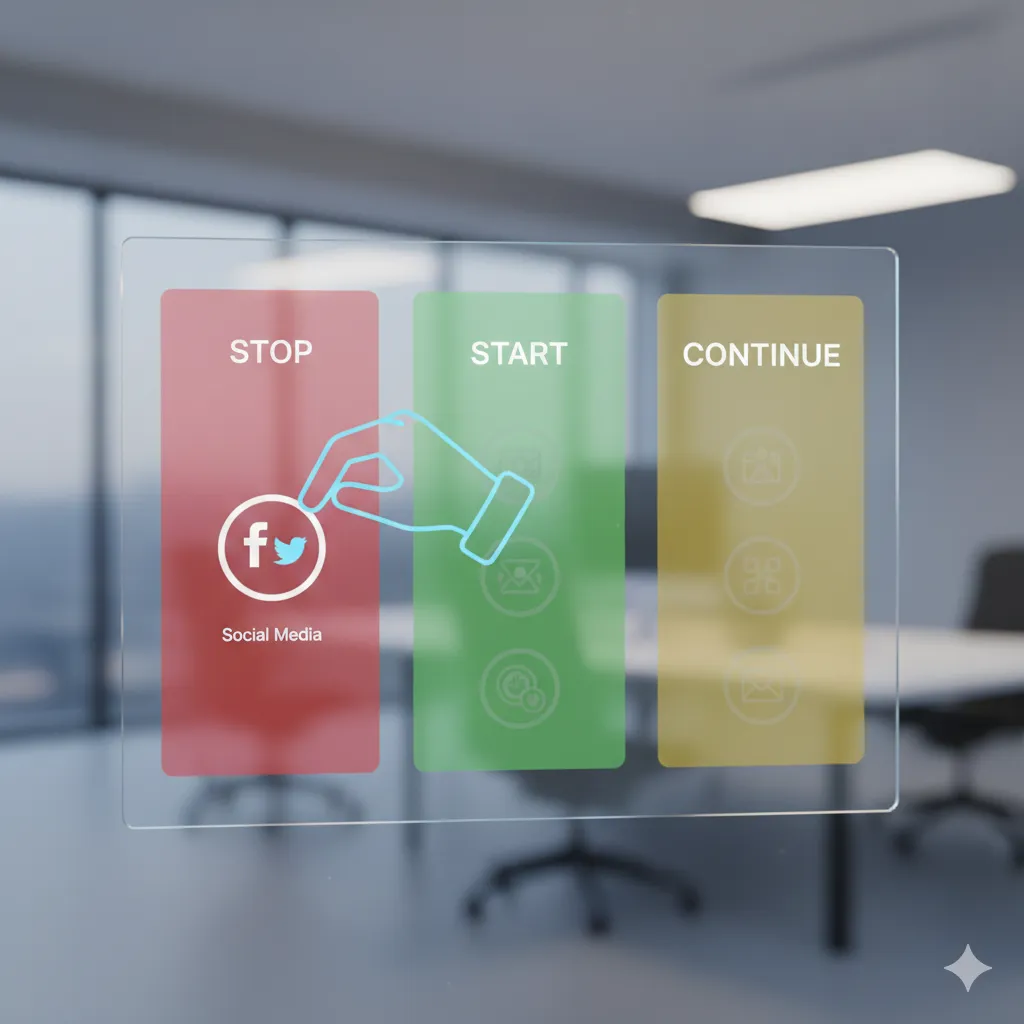
🛑 STOP (The Bugs)
What drained your energy with zero return on investment?
- The “Fauxductivity” of replying to Teams/Slack/WhatsApp instantly?
- Doomscrolling in bed? (See: The ROI of Boredom). 4
- Saying “Yes” to all coffee chats that distract from Deep Work?
Rule: Be ruthless. If it cost you peace and gave you nothing, kill it.
🟢 START (The Features)
What is one hypothesis you want to test in February?
- Start a morning walk?
- Start putting the phone in the kitchen at night?
- Start a “No Meeting Friday”?
Rule: Pick ONE. Do not try to install 10 new features at once. Your system will crash.
🟡 CONTINUE (The Wins)
What actually worked?
- Did meal prepping save your sanity?
- Did blocking time for Deep Work help you ship that project?
Rule: Double down on what fuels you.
Adjusting Your F.A.K.E. Framework
Finally, run your month through our core F.A.K.E. Framework (Focus, Alignment, Knowledge, Energy). 5

- Focus: Did you protect your attention for Deep Work, or did you fragment it across ten different tabs?
- Alignment: Did your daily actions actually map to your long-term vision? Or did you spend the month climbing a ladder that was leaning against the wrong wall?
- Knowledge: What did you learn from your bugs? (Remember: Failure isn’t a loss; it’s tuition. If you learned why you failed, you gained Knowledge).
- Energy: Did you manage your biological battery, or did you try to run a marathon on empty?
If January felt “heavy”,
it’s usually because you broke Alignment (doing work that doesn’t matter to you),
or drained Energy (ignoring your recovery).
Frequently Asked Questions (FAQ)
What if I achieved NOTHING in January?
Impossible. Even if you missed every goal, you generated data. You learned exactly what doesn’t work for you. That is valuable. Thomas Edison didn’t fail; he found 10,000 ways that didn’t work. You found 30 days of ways that didn’t work. Use that data.
How long should a Monthly Review take?
30 minutes max. If it takes longer, you are procrastinating. Keep it high-level. This is a “strategic check-in”, not a forensic audit.
Conclusion: February v2.0
You are not the same person today that you were on January 1st. You are smarter. You have battle scars. You have data.
Don’t set “New Year’s Resolutions” anymore. Set “February Iterations”.
You have debugged the code. You have closed the zombie loops. You are ready to launch February v2.0.
Let’s build 💪
🌿 Join the Community
If you want to share your “STOP” item for February, come join us in the Productivity Nirvana Community. Radical honesty is easier when you aren’t doing it alone.
This article is a co-creation of myself (Erick Stoic) with Google Gemini and Nano Banana 🍌.
References & Further Reading
- Zeigarnik, B. (1927). On Finished and Unfinished Tasks. In W. D. Ellis (Ed.), A Source Book of Gestalt Psychology. https://psycnet.apa.org/record/2007-10344-025↩︎
- The Sustainable Productivity Blog. “Deep Work in the Age of AI”. https://thesustainableproductivity.com/deep-work-age-of-ai/↩︎
- The Sustainable Productivity Blog. “The Neuro-Productivity Manifesto: Why Resolutions Fail Your Brain”. https://thesustainableproductivity.com/the-neuro-productivity-manifesto-why-resolutions-fail-your-brain/↩︎
- The Sustainable Productivity Blog. “The ROI of Boredom”. https://thesustainableproductivity.com/roi-of-boredom/↩︎
- The Sustainable Productivity Blog. “The F.A.K.E. Framework: A Human Alternative to SMART Goals for 2026”. https://thesustainableproductivity.com/the-f-a-k-e-framework-a-human-alternative-to-smart-goals-for-2026/↩︎
- Beck, K., et al. (2001). Manifesto for Agile Software Development. Agile Alliance. https://agilemanifesto.org/
- Newport, C. (2016). Deep Work: Rules for Focused Success in a Distracted World. Grand Central Publishing. https://calnewport.com/deep-work/