
Category: Good Habits
-
The Chronotype Audit: Why 65% of You Are Scheduling Like the Wrong Species

What if the reason your 5 a.m. routine failed wasn’t lack of discipline, but biology? This article reveals why 65% of people are “Third Birds” whose cognitive peak hits mid-morning, not at dawn. Drawing on Daniel Pink’s research, it maps the three chronotypes (Larks, Third Birds, Owls), explains the daily performance arc, and introduces a… Read more
-
The April Experiment: What I Learned Going Slower in an AI World Telling Me to Speed Up

The April Experiment is a 30‑day slow productivity lab in the middle of an AI boom that keeps telling us to move faster. Instead of adding more tools, I cut my AI stack from eleven to three, rebuilt my weeks around deep work, and used the F.A.K.E. Framework to delete the “AI made it easy”… Read more
-
The Antidote to AI Velocity: Why Human Presence is the 2026 Productivity Premium

In a world where AI can ship code, content, and campaigns faster than your nervous system can blink, velocity is no longer your edge, it’s your trap. This article shows how “AI Velocity” silently creates communication debt, cognitive overload, and burnout, and why the real 2026 productivity premium is your presence: deep focus, emotional intelligence,… Read more
-
Valentine’s Special: Why NVC is the Best Gift for Your Productivity

The most expensive distraction in your home office isn’t Netflix or your phone, it’s the unresolved tension you carry from your living room into your laptop screen. This Valentine’s, instead of defaulting to chocolates or flowers, discover how Non‑Violent Communication (NVC) can turn domestic friction into emotional clarity, protect your focus blocks, and unlock genuinely… Read more
-
The Over-Optimization Backlash: Moving from KPIs to Connection in 2026

You’ve optimized every minute of your existence, yet you feel more depleted than ever. The Over-Optimization Backlash of 2026 marks a radical shift: moving from KPIs and surveillance to Sustainable Productivity built on nervous system regulation and human connection. Discover the F.A.K.E. Framework, co-regulation, and why boredom is your secret weapon for genuine high performance. Read more
-
The January Post-Mortem: Why You Failed Your Goals (And How to Fix It for February)

The January Post-Mortem is a guided monthly review for people who “failed” their New Year’s resolutions and don’t want to repeat the same mistakes in February. Instead of blaming willpower, it treats your life like a product: you close open loops draining your energy, then run an Agile-style Retrospective using Start / Stop / Continue… Read more
-
The ROI of Boredom: Why You Cannot Live a “Soft Life” with a Fried Nervous System

Stop chasing the “Soft Life” with a fried nervous system. Discover why willpower fails against the attention economy, why boredom is your superpower, and the 3-step Digital Friction Protocol to reclaim your focus and reset your dopamine baseline. Read more
-
Deep Work in the Age of AI: Your Only Survival Strategy (Not Just a Buzzword)
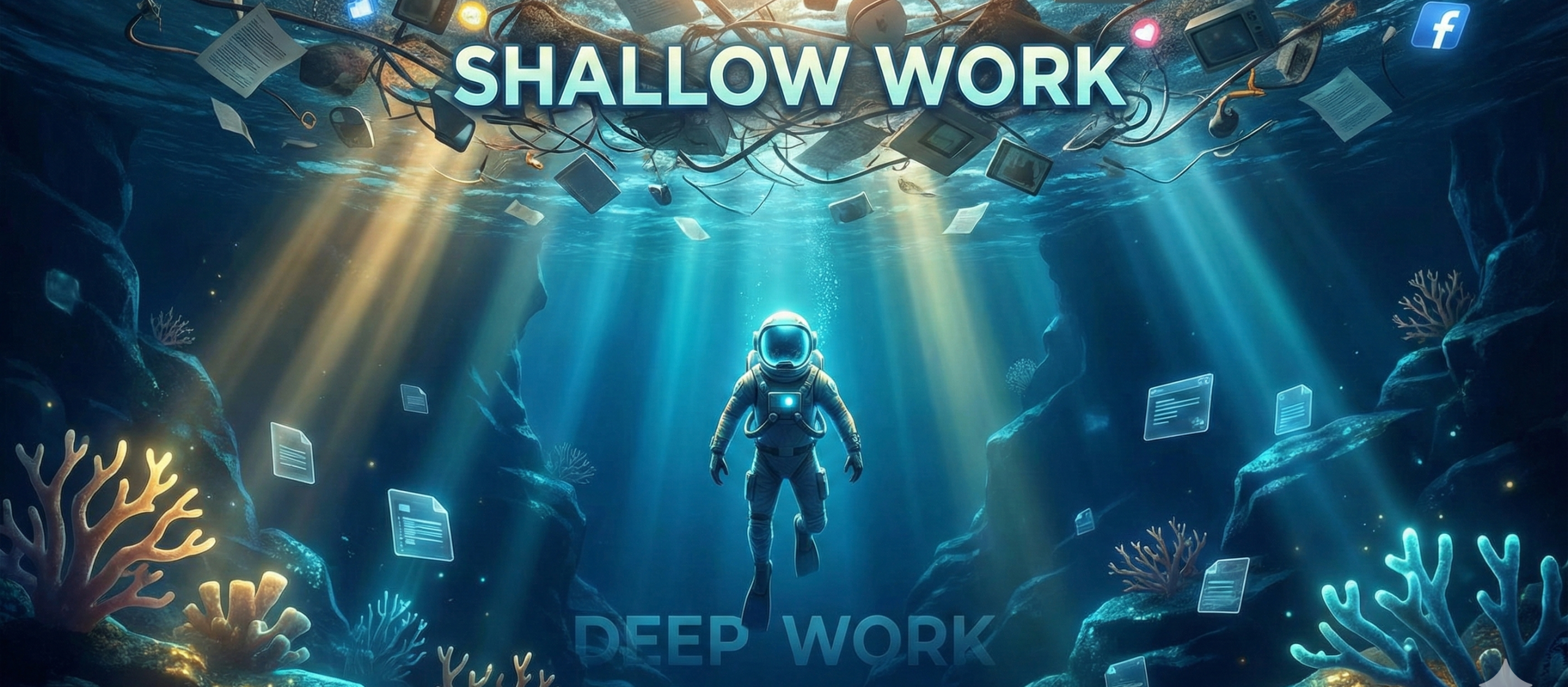
The headlines are exhausting, aren’t they? “AI replaces coders,” “AI writes better copy,” “AI manages projects”. If you are a knowledge worker (e.g., a developer, designer, product manager, project manager) you have felt that cold shiver of obsolescence. If an algorithm can do the “busy work” 100x faster than you, what is your value? Here… Read more
-
The Progress Principle: How Small Wins Hack Your Dopamine (And Cure Burnout)

The Progress Principle emphasises that consistent small wins are crucial for maintaining productivity and motivation. By breaking down large tasks into manageable steps and celebrating incremental progress, individuals can refuel their dopamine levels and combat burnout. This approach fosters sustainable productivity by shifting focus away from distant goals. Read more
-
The Art of Quitting: Why “Quitter’s Day” is Your Best Opportunity to Pivot

Most people view January 9 as the day resolutions fail, known as Quitter’s Day. However, it can be an opportunity to reassess goals and implement strategic quitting using the TSP Method. Emphasising adaptability, the article suggests reengineering resolutions to align better with personal aspirations for a sustainable, productive 2026. Read more