

The most expensive distraction in your home office isn’t Netflix or your phone. It’s the unresolved argument you had with your partner at 8:45 AM.
When you sit down to code, design, or manage a product, but your brain is still looping on a “passive-aggressive” comment about the dishes, you aren’t working.
You are performing emotional labor while trying to do intellectual work. For hybrid and remote professionals, the line between home life and work life doesn’t exist. If there is friction in your living room, there is friction in your output.
This Valentine’s season, we’re moving beyond chocolates. We’re talking about Non-Violent Communication (NVC), not just as a relationship tool, but as a high-performance “firmware update” for your brain.
TL;DR: Key Takeaways
- Emotional Friction is a Productivity Killer: Unresolved domestic conflict creates “communication debt”, which drains the cognitive energy required for deep work.
- NVC as a System: Non-Violent Communication (Observations, Feelings, Needs, Requests) acts as a protocol to resolve friction before it hits your calendar.
- Boundaries = Love: Setting firm work-from-home boundaries isn’t “selfish”; it’s an act of care that prevents burnout and resentment.
- The ROI of Peace: Reducing “friction hours” can reclaim up to 5-10 hours of focused work per week.

What is Non-Violent Communication (NVC) and why does it matter for productivity?
Non-Violent Communication (NVC) is a four-step “communication framework” (Observations, Feelings, Needs, and Requests) that removes blame from interactions.
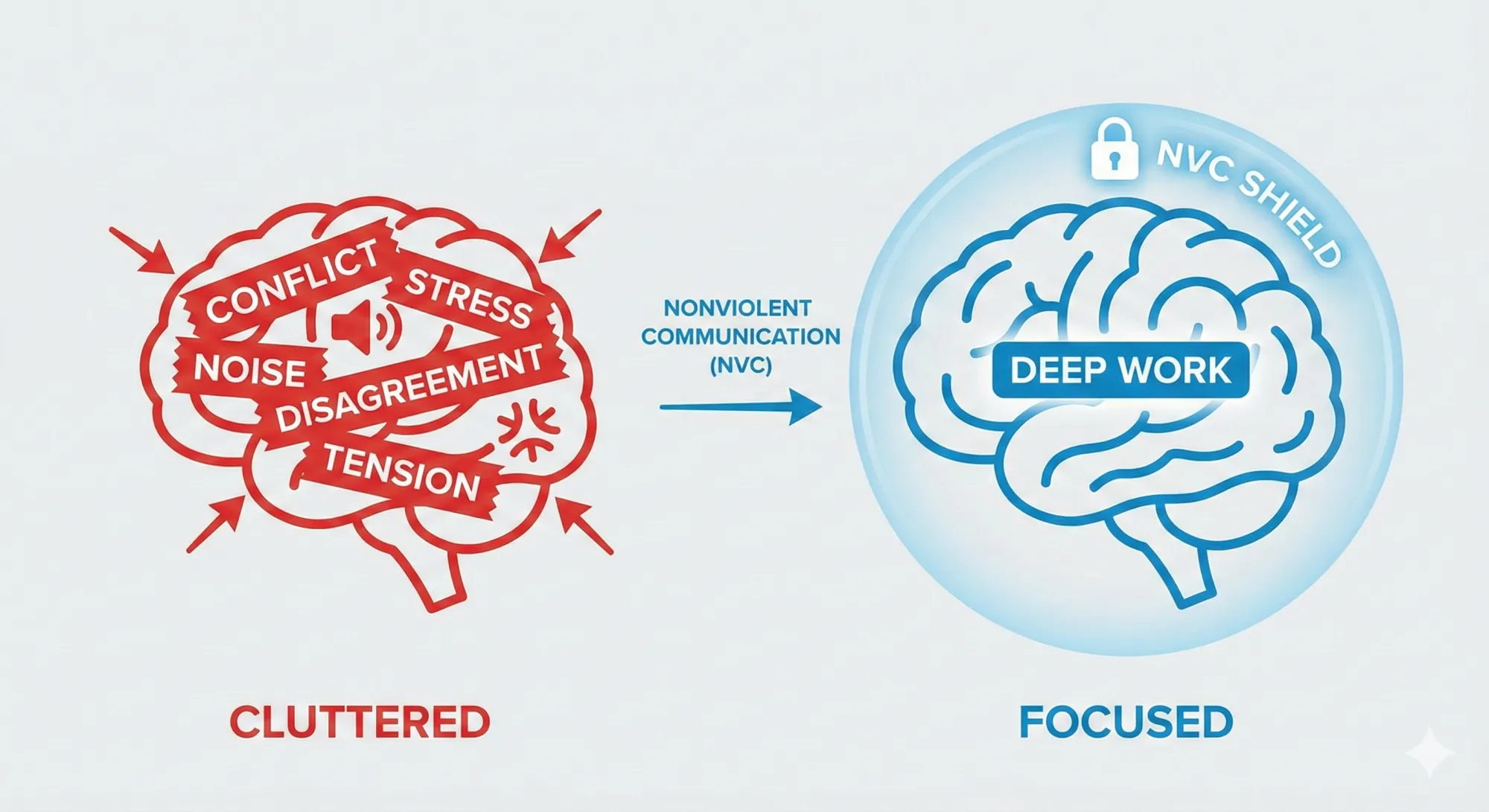
For productivity, it matters because it eliminates “emotional friction”, the cognitive drain caused by misunderstandings and resentment. By resolving conflict quickly, you preserve your prefrontal cortex’s energy for deep, complex tasks rather than ruminating on social stress.
When we talk about “violence” in communication, we don’t just mean shouting. We mean the subtle ways we use judgment, demands, and labels to get our way. As a remote professional, you deal with “Communication Debt”. 1
Just like technical debt, communication debt happens when you take the easy way out of a hard conversation (e.g., being passive-aggressive instead of clear). Eventually, the interest on that debt, burnout and distraction, becomes too high to pay.
By using NVC, you stop reacting to the “tone” of a message and start identifying the needs behind it. This shift in perspective is the ultimate hack for sustainable productivity.
How does domestic peace impact your ability to reach Deep Work?
Domestic peace acts as the foundation for Deep Work because the human brain is neurobiologically wired to prioritise social safety over cognitive tasks.
When your home environment is tense, your amygdala remains on high alert, making it impossible to enter a flow state. A peaceful home environment lowers cortisol, allowing for the prolonged focus necessary for high-level professional output.
Think about the last time you had a “cold war” morning with a partner or roommate. You sat at your desk, opened your notebook to work, open your IDE or Figma, and… you didn’t manage to finish anything. Your brain was busy rehearsing what you should have said.
Deep Work requires a “clean” mental slate. If you are a web developer or a product owner, your value lies in your ability to solve complex problems. You cannot solve those problems if 30% of your RAM is dedicated to domestic stress. As we discussed in our ROI of Emotional Regulation post, protecting your focus blocks starts with protecting your emotional baseline.
Why setting boundaries is the ultimate “Act of Love” for your career
Setting boundaries is an act of love because it prevents the resentment that naturally builds when one’s needs are consistently ignored.
By clearly communicating your “Do Not Disturb” times using NVC, you protect the quality of your work while ensuring that when you are “off-clock,” you can be fully present and loving with your family or partner.
Many remote professionals feel guilty saying “No” to a family member during the day. However, guilt-driven work is rarely high-quality work. When you fail to set a boundary, you end up doing “shallow work” while feeling resentful.
Using NVC to set a boundary looks like this:
“When I see the office door open during my deep work block (Observation), I feel anxious (Feeling) because I need uninterrupted focus to finish my work (Need). Would you be willing to check the ‘On Air’ light before coming in? (Request).”
This isn’t a wall; it’s a bridge. It tells the other person exactly how to support your personal/professional growth.
The NVC Protocol for Hybrid Professionals
To help you implement this, use the following table to translate “Violent” (Normal) communication into “Productive” (NVC) communication.
| Traditional Communication (High Friction) | NVC Translation (Low Friction) | Productivity Impact |
|---|---|---|
| “You’re always interrupting me!” | “When I’m on a call and hear loud music (O), I feel frustrated (F) because I need silence (N). Can we use headphones until 5 PM? (R)” | Reclaims focus immediately. |
| “You don’t respect my work hours.” | “When you ask me to do chores at 2 PM (O), I feel overwhelmed (F) because I need to keep my flow (N). Let’s sync on chores at 6 PM? (R)” | Prevents “context switching” drain. |
| “I’m fine. Just busy.” (Passive) | “I feel stressed (F) because I need some quiet time (N) to recover from this meeting. I’ll be out in 20 minutes (R).” | Stops the “rumination loop” for both parties. |
The “Kitchen Table Protocol”: Systematizing Peace
Just as you have a “Daily Standup” for work, you need a system for your home life to maintain Sustainable Productivity.
- Weekly Sync: Every Sunday, look at each other’s calendars. Identify “High Focus” blocks.
- The “Safety Valve”: Agree that if someone uses a specific phrase (e.g., “I’m in a focus tunnel”), the other person will not take it personally.
- Needs over Demands: Instead of demanding help, express the need for support.
Recommended Reading: To understand the biological roots of why focus fails when we are stressed, check out The Neuro-Productivity Manifesto. 2
Frequently Asked Questions (FAQ)
Does NVC take too much time during a busy workday?
No. While it feels slower initially, NVC saves hours of “emotional cleanup” later. Resolving a tension in 5 minutes of clear communication prevents 5 hours of distracted, low-quality work.
Can I use NVC with my boss or clients?
Yes. NVC is highly effective for managing “Scope Creep”. By stating the observation (new tasks) and your need (quality/deadlines), you can make requests for prioritisation without sounding defensive.
What if my partner doesn’t use NVC?
You don’t need both people to know the “rules” for NVC to work. By changing how YOU respond, focusing on their needs rather than their tone, you naturally de-escalate the friction.
Conclusion: Give Yourself the Gift of Focus
Productivity isn’t just about the best Notion template or the fastest laptop. It’s about the quality of your internal environment. This Valentine’s, give yourself and your loved ones the gift of clarity.
When you reduce the emotional noise in your life, high performance becomes a natural byproduct, not a forced struggle. You deserve to work in a way that doesn’t cost your peace.
If you want the full system I use to harmonize high-level tech work with a sustainable lifestyle, come join us in the Productivity Nirvana Community & Online Course.
This article is a co-creation of myself (Erick Stoic) with Google Gemini and Nano Banana 🍌.
References & Further Reading
- The Sustainable Productivity. The ROI of Emotional Regulation: Why NVC is the Ultimate 2026 Productivity Hack. https://thesustainableproductivity.com/roi-of-emotional-regulation/↩︎
- The Sustainable Productivity. The Neuro-Productivity Manifesto: Why Resolutions Fail Your Brain. https://thesustainableproductivity.com/the-neuro-productivity-manifesto-why-resolutions-fail-your-brain/↩︎
- Rosenberg, M. B. (2015). Nonviolent Communication: A Language of Life. Puddledancer Press. https://www.amazon.com/Nonviolent-Communication-Language-Life-Changing-Relationships/dp/189200528X
- Newport, C. (2016). Deep Work: Rules for Focused Success in a Distracted World. Grand Central Publishing. https://www.amazon.co.uk/Deep-Work-Focused-Distracted/dp/0349411905/
- The Sustainable Productivity. The Neuro-Productivity Manifesto: Why Resolutions Fail Your Brain. https://thesustainableproductivity.com/the-neuro-productivity-manifesto-why-resolutions-fail-your-brain/