

You’ve felt it. That stomach-drop feeling when a Teams/WhatsApp/Slack message from your Manager hits the screen at 4:55 PM. Or the simmering resentment after a video call where your ideas were talked over.
For the modern hybrid professional (the dev, the designer, the founder), productivity isn’t just about your IDE or your Notion setup. In 2026, the biggest drain on your output isn’t a slow Wi-Fi connection; it’s emotional friction.
Emotional regulation through Nonviolent Communication (NVC) is the secret weapon for high performance. It’s not just “soft skills”, it’s a tactical framework to protect your most valuable asset: your deep work blocks.
TL;DR: Key Takeaways
- Reduce “Friction Hours”: NVC eliminates the hours spent overthinking, venting, or re-reading tense emails.
- Protect Your Focus: Emotional regulation prevents “amygdala hijacks” that shatter deep work sessions.
- Reclaim 5+ Hours Weekly: Efficient communication allows you to finish your “day job” faster and focus on passive income or personal growth.
What is Emotional Regulation in a Remote Work Context?
Emotional regulation is the ability to monitor and manage your internal state. So, that your reactions remain aligned with your long-term goals rather than temporary impulses.
When you work remotely, you lose the “hallway context” of human interaction. A short sentence in an email/message can be interpreted as a personal attack. Without emotional regulation, your brain enters a stress-response state, spiking cortisol and killing your ability to do creative and strategic work. 1
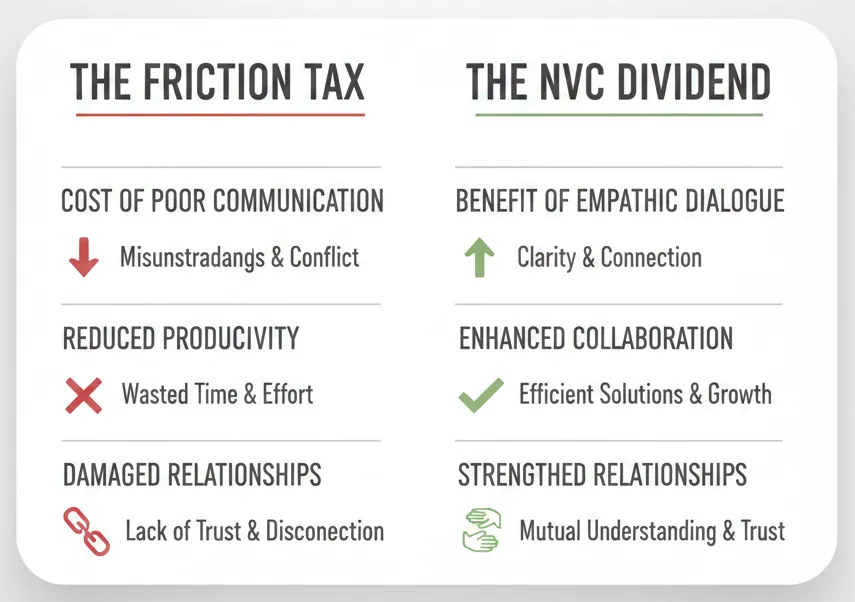
The Cost of High-Conflict Communication
| Metric | Low Emotional Regulation | High Emotional Regulation (NVC) |
|---|---|---|
| Recovery Time | 2-3 hours after a “heated” meeting | 5-10 minutes to reset |
| Communication Style | Defensive / Passive-Aggressive | Objective / Observation-based |
| Weekly Time Waste | ~7 hours of “rumination” | < 1 hour of clarification |
| Energy Levels | Constant “Low-grade” burnout | Sustainable high-output |
How Does Nonviolent Communication (NVC) Increase Your ROI?
NVC increases your ROI by transforming conflict into data, allowing you to resolve team blockers in half the time while preserving your mental energy for high-leverage tasks.
Developed by Marshall Rosenberg, NVC has a four-step “framework”/”model” : Observations, Feelings, Needs, and Requests. For a Product Owner or developer, this is essentially “debugging” human interaction. 2
1. Eliminating “Friction Hours”
How many times have you spent an hour drafting a “professional” rebuttal to a critique? That is a friction hour. By using NVC, you skip the ego-defense and move straight to the solution. You aren’t just being “nice”; you are being computationally efficient with your brainpower.
2. Guarding the Amygdala
When you receive a harsh PR review, your amygdala (the brain’s fear center) can take over. NVC allows you to observe the feedback (Observation) without attaching it to your self-worth (Feelings). This keeps you in the Prefrontal Cortex, where your best work happens.
Recommended Reading: As we discussed in our recent guide on ‘The ROI of Boredom‘, managing your biological responses is the first step to scaling your output.
The 4-Step NVC Framework for Hybrid Teams
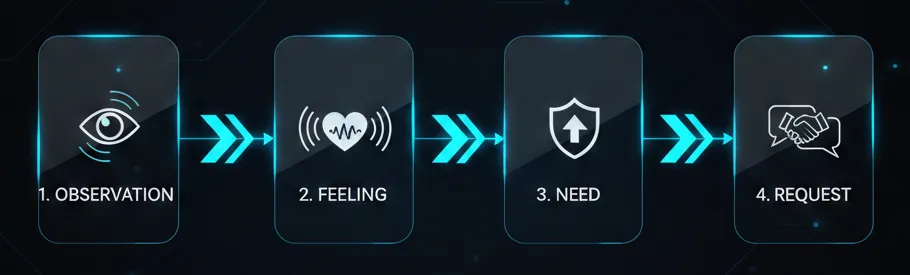
To implement the ROI of Emotional Regulation, you need to treat communication like a deployment pipeline.
Step 1: Observation (The Log File)
State the facts without evaluation. Instead of “You’re always late with the assets,” try “I noticed the Figma file was shared at 10 AM instead of 8 AM.”
Step 2: Feeling (The Internal State)
Own your reaction. “I feel anxious because the deadline is approaching,” rather than “You’re making me stressed.”
Step 3: Need (The Requirement)
Identify the underlying value. “I have a need for predictability to manage my deep work blocks.”
Step 4: Request (The Action Item)
Make a specific, doable request. “Would you be willing to message me 24 hours in advance if a delivery will be late?”
The 3 NVC “Slack-Ready” Templates
Scenario A: The “Vague/Passive-Aggressive Feedback” Debugger
- Context: Someone says “This isn’t what we discussed” without detail.
- NVC Script:“I noticed your comment that this differs from our discussion (Observation). I feel confused because I want to ensure I’m hitting the requirements (Feeling). I have a need for clarity to avoid rework (Need). Would you be open to a 5-minute huddle to highlight the specific gaps? (Request)”
Scenario B: The “After-Hours Slack” Boundary
- Context: A PM pings you at 8 PM for a non-emergency.
- NVC Script:“I see your message regarding the ticket (Observation). I feel protective of my evening deep-recovery time (Feeling) because I value being 100% sharp for the team tomorrow (Need). Would it work for you if I address this first thing at 9 AM? (Request)”
Scenario C: The “Interrupted in Zoom” Reset
- Context: You get talked over during a demo.
- NVC Script:“I noticed I wasn’t able to finish the explanation of the API logic (Observation). I feel frustrated because I want to make sure the full context is understood (Feeling/Need). Would you be willing to let me finish this slide before we move to Q&A? (Request)”
Reclaim 5 hours a week to master anything, more time for family or hobbies, or generate passive income
By applying NVC, you reclaim 5+ hours weekly by cutting out redundant meetings, reducing “clarification” threads, and preventing the mental fatigue that leads to “revenge bedtime procrastination”.
If you are a freelancer or entrepreneur, those 5 hours are the difference between a stagnant business and a growing passive income stream.
When you aren’t “recovering” from your 9-to-5, you have the surplus energy to build your own products.
This is the ultimate productivity hack of 2026: **Emotional Efficiency** 3
Frequently Asked Questions
Does NVC make me look “weak” in a corporate environment?
No. In fact, NVC often makes you more authoritative and composed. It demonstrates high Emotional Intelligence (EQ), a trait highly valued in leadership roles. By remaining objective, you control the narrative of the conversation.
How do I use NVC when my boss is aggressive?
Focus on “Empathic Listening”. When they vent, mentally translate their “attacks” into their unmet needs. This prevents you from taking the bait and allows you to steer the conversation back to actionable outcomes.
Can this really help me avoid burnout?
Yes, because burnout is often caused by a sense of powerlessness and chronic stress. NVC gives you a toolset to express your needs and set boundaries effectively, which directly counters the “learned helplessness” that leads to burnout.
Conclusion: Your Move Toward Productivity Nirvana
The most successful professionals in 2026 won’t be the ones who work the longest hours; they will be the ones with the most regulated nervous systems. By adopting NVC, you stop leaking energy into unnecessary conflicts and start reinvesting it into your craft.
Stay tuned for our YouTube Live on March 1st about NVC (Nonviolent Communication)! Subscribe to my Blog/Newsletter (👇) or connect+follow me on LinkedIn to be the first to receive the link.
If you’re ready to stop the cycle of burnout and build a system that supports both your career and your well-being, come join our Productivity Nirvana Community & Online Course.
We dive deep into the mechanics of sustainable high performance. Check out the full system here.
This article is a co-creation of myself (Erick Stoic) with Google Gemini and Nano Banana 🍌.
References & Further Reading
- Using Neuroscience to Broaden Emotion Regulation: Theoretical and Methodological Considerations | Elliot T Berkman, Matthew D Lieberman | https://pmc.ncbi.nlm.nih.gov/articles/PMC3775274/↩︎
- Nonviolent Communication: A Language of Life | Marshall B. Rosenberg | https://www.amazon.com/Nonviolent-Communication-Language-Life-Changing-Relationships/dp/189200528X↩︎
- Emotional Intelligence and Job Performance | Frontiers in Psychology (2024) | https://www.frontiersin.org/journals/psychology/articles/10.3389/fpsyg.2024.1425465/full↩︎