
The irony is not lost on me. You are reading this on a screen.
You have five other tabs open, or more. Your Microsoft Teams or Slack icon is bouncing. A notification just slid across your phone screen. Your brain is already calculating how fast you can skim this before the next dopamine hit arrives.
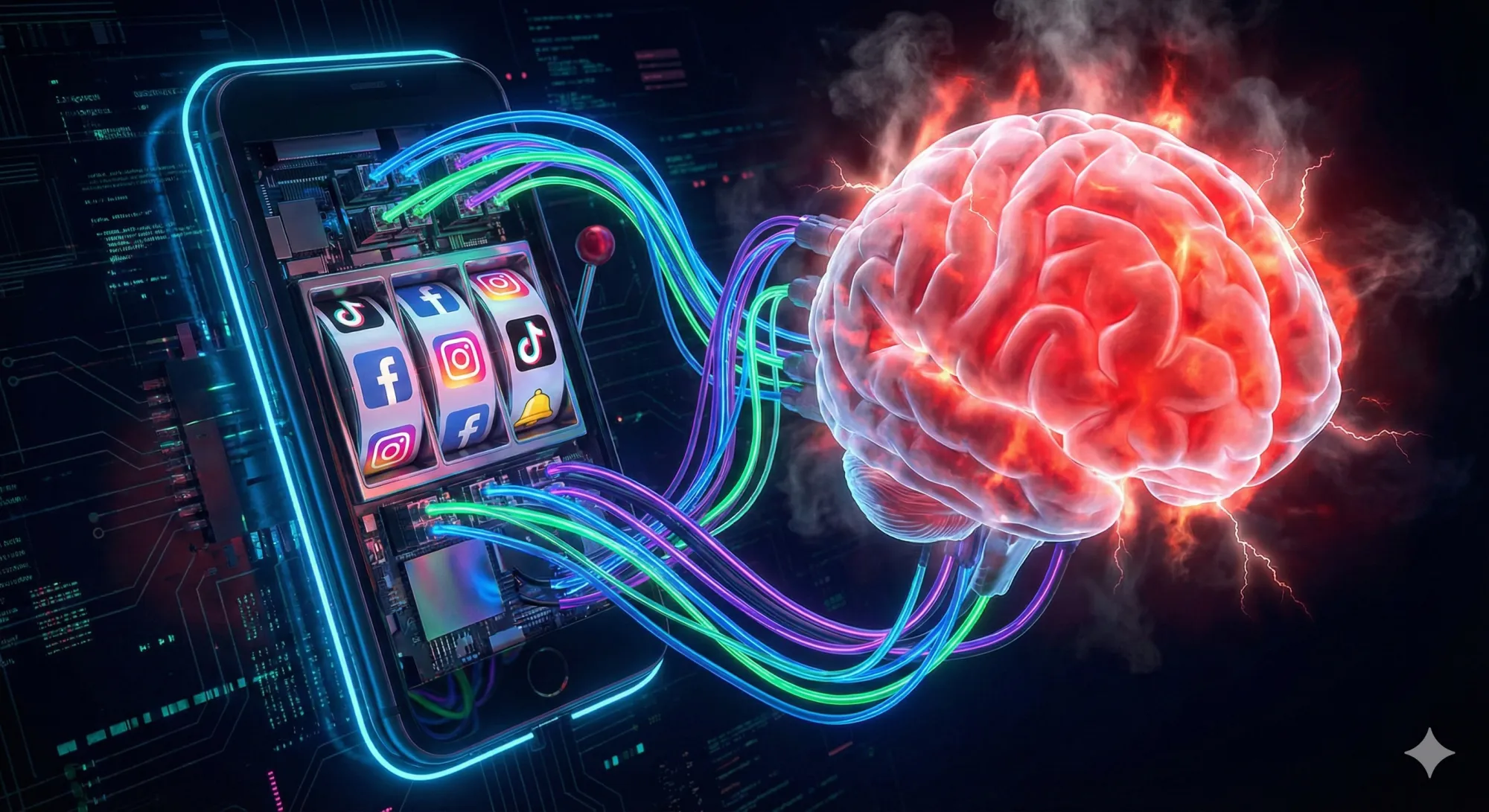
This is the reality of the Attention Economy. Your phone is not a tool; it is a slot machine designed by some of the smartest behavioral psychologists in the world to hijack your survival instincts.1
If you feel “fried,” anxious, or unable to sit still for 10 minutes, you are not broken. You are just losing a game you didn’t know you were playing.
As we discussed in our recent guide on Deep Work2, you cannot build a cognitive fortress if the drawbridge is always down.
⚡ TL;DR: Key Takeaways
- Willpower is a Myth: You cannot “willpower” your way out of addiction to algorithms trained on billions of data points. You need systems.
- The Soft Life Requires Hard Boundaries: You cannot live a life of ease and flow if your nervous system is stuck in reactive “survival mode”.
- Digital Minimalism is a Strategy: It is not about smashing your phone; it is about optimising tech for utility rather than entertainment.
The ROI of Boredom:
Reclaiming boredom is the only way to reset your dopamine baseline and unlock deep creativity.
The “Slot Machine” in Your Pocket (Why Willpower Fails)
Why does willpower fail when trying to reduce screen time?
Willpower fails because you are fighting a supercomputer. Social media algorithms are designed as “variable reward schedules”, the same psychological mechanism used in slot machines.
Every time you pull-to-refresh, your brain anticipates a dopamine spike. Fighting this biological loop with sheer force of will is biologically expensive and ultimately ineffective. You must change the environment, not just your mindset.
When you rely on willpower, you are burning glucose in your prefrontal cortex. Eventually, you get tired (decision fatigue), and the algorithm wins.
The goal of Digital Minimalism isn’t to be stronger; it’s to be smarter than the machine.
The “Soft Life” Paradox
There is a trend sweeping social media called the “Soft Life”. It champions ease, peace, and rejecting the grind.
But here is the paradox: You cannot live a “Soft Life” with a hardened nervous system.
If you are checking your email at 10 PM, or if your heart rate spikes every time your phone buzzes, you are living a “Hard Life”, biologically speaking. Your body is flooded with cortisol. You are in a state of constant, low-grade fight-or-flight.
True luxury in 2026 isn’t a designer bag. It is a regulated nervous system.To achieve the “Soft Life”, you must be hard on your distractions. You must prioritise your Peace as a financial asset.
Digital Minimalism: A Philosophy of Use
Digital Minimalism is not about rejecting technology. It is a philosophy of technology use.
You focus your online time on a small number of carefully selected activities. These activities strongly support the things you value. 3
It’s the difference between using a hammer to build a house. This is a tool. It’s also the difference between hitting yourself in the thumb because you can’t put the hammer down. This is an addiction.
The Minimalist vs. The Maximalist
| Feature | The Digital Maximalist | The Digital Minimalist |
|---|---|---|
| Notification Strategy | All notifications on (“Fear Of Missing Out”) | Only human-to-human texts/calls allowed |
| Phone Location | Beside the bed, in the bathroom, on the desk | In the kitchen, in a bag, out of sight |
| Boredom Tolerance | Zero (Must fill every gap with scrolling) | High (Uses boredom to think or rest) |
| Social Media Use | Passive scrolling (Consumer) | Intentional posting/connection (Creator) |
As we explore in The F.A.K.E. Framework, aligning your actions with your Energy is critical. Digital Minimalism is the tool that protects that energy.
The 3-Step “Digital Friction” Protocol
How do you break the addiction loop?
To break the digital addiction, you must increase the “interaction cost”. Biology dictates that we follow the path of least resistance.
Adding intentional friction is crucial. Use techniques like physical distance, greyscale screens, or complex passwords. This gives your prefrontal cortex the 3-second window it needs to override the impulse and make a conscious choice.

Step 1: The “Dumb” Smart Phone 📵
Make your phone a tool, not a toy.
- Greyscale Mode: Turn your screen black and white. It instantly makes Instagram look like a boring newspaper.
- Delete the “Infinity Pools”: Remove any app that has an infinite scroll (TikTok, Twitter, Instagram) from your phone. Use them on your desktop only.
- Notifications: Turn off everything except texts and calls. No email, no Slack, no “likes”.
Step 2: The Physical Separation 🏠
Your phone does not need to sleep next to you.
- The Foyer Rule: When you walk in the door, plug your phone into a charger in the hallway or kitchen. It stays there.
- Buy an Alarm Clock: Stop using your phone to wake up.
Step 3: Reclaim Boredom 🚶
We have forgotten how to be bored.
- Go for a walk without a podcast.
- Do the dishes without YouTube.
- Sit in a waiting room without checking email.
Boredom is where the “Default Mode Network” (DMN) in your brain activates.
This is where creativity, problem-solving, and self-reflection happen. 4
If you numb boredom, you kill innovation.
What to Do with the Silence? (The Withdrawal Phase)
🚨 Warning: The first 72 hours will be uncomfortable. 🚨
You will feel “phantom vibrations”. You will reach for your pocket 50 times a day. You will feel a spike of anxiety: “What am I missing?”
This is the withdrawal. It is proof that the Digital Detox is working.
Use this newfound time and silence to engage in high-value leisure:
- Read a physical book.
- Have a conversation where you actually look at the person’s eyes.
- Engage in a hobby that requires your hands (cooking, woodworking, painting).
Frequently Asked Questions (FAQ)
Can I practice Digital Minimalism if I work in tech?
Yes, in fact, it is even more critical. You must distinguish between “Professional Tool Use” (coding, specific research) and “Passive Entertainment”.
Set rigid boundaries: Work happens on the computer. The phone is for communication only and periodically re-analyse if you really need to keep ‘notifications on’.
How long does a Digital Detox take to work?
You will feel a difference in your anxiety levels within 48 hours. However, a full dopamine reset to restore your baseline motivation typically takes 30 days of consistent practice.
Will I lose touch with friends?
You might lose touch with “connections”, but you will deepen relationships with friends. Digital Minimalism encourages high-bandwidth communication (calls, coffee dates) over low-bandwidth signals (likes, comments).
Conclusion: The Attention Asset
In the AI Era, information is cheap. Attention is expensive.
Your ability to command your own focus is your competitive advantage. Sit with a problem, listen to a partner, enjoy a sunset without filming it ❤️
Don’t give this asset away for free to an app that sells your data to advertisers.
The “Soft Life” is waiting for you. But you have to put the phone down to live it.
🌿 Start Your Reset Today
If you are ready to completely rebuild your work habits, you might be interested in the full Productivity Nirvana Community & Online Course.
This article is a co-creation of myself (Erick Stoic) with Google Gemini and Nano Banana 🍌.
References & Further Reading
- Alter, A. (2017). Irresistible: The Rise of Addictive Technology and the Business of Keeping Us Hooked. Penguin Press.↩︎
- The Sustainable Productivity Blog. “Deep Work in the Age of AI.” https://thesustainableproductivity.com/deep-work-age-of-ai/↩︎
- Newport, C. (2019). Digital Minimalism: Choosing a Focused Life in a Noisy World. Portfolio.↩︎
- Immordino-Yang, M. H., et al. (2012). Rest Is Not Idleness: Implications of the Brain’s Default Mode for Human Development and Education. Perspectives on Psychological Science.↩︎