

You adopted AI early. You shipped faster. You took on more. You cleared your backlog.
And then, somewhere around month three, you noticed something uncomfortable: you were more exhausted than before you started using any of it.
That’s not a personal failure. That’s not a mindset issue. That’s a documented, peer-reviewed phenomenon, and the researchers who named it called it AI burnout for a reason.
Welcome to AI Brain Fry.
TL;DR – Key Takeaways
- AI burnout is real and spreading fast. UC Berkeley researchers embedded inside a 200-person tech firm for 8 months found AI intensifies work, not reduces it.¹
- The people using AI the most are burning out the fastest. The early adopters are the first casualties.²
- BCG’s data shows productivity peaks at 3 AI tools, then crashes. Four or more tools and your output drops while your cognitive strain keeps rising.³
- The F.A.K.E. Framework (Focus · Alignment · Knowledge · Energy) is the filter that stops AI from expanding your workload instead of reducing it.
What Is AI Brain Fry, and Why Should You Care?
AI brain fry is a specific form of cognitive fatigue caused by the excessive use, oversight, and context-switching between AI tools. It produces mental fog, slower decision-making, more errors, and a growing inability to step away from work.
Boston Consulting Group gave it a name after surveying 1,488 full-time workers.³
But if you’ve felt it, you already know the symptoms:
- You finish the day busier than when you started, even though AI was “helping”
- You can’t tell when work ends anymore
- You feel productive but hollow (a lot of output, not much meaning)
- You’re spending more time reviewing AI outputs than you used to spend just doing the work
BCG researchers found that workers constantly switching between multiple AI tools reported more decision fatigue, more errors, and about one in seven said they had experienced significant mental fatigue from juggling AI tools at work.
Here’s the brutal irony: the people experiencing AI burnout the hardest aren’t the skeptics. They’re the enthusiasts. The early adopters. The people doing everything right.
The UC Berkeley Study No One Is Talking About Enough
UC Berkeley researchers spent eight months inside a 200-person U.S. tech firm, conducting over 40 in-depth interviews across engineering, product, design, research, and operations.
What they found was that AI tools increased both the volume of work employees could complete and the variety of tasks they took on; even when they weren’t asked to.
The headline from that study, published in Harvard Business Review: **AI doesn’t reduce work. It intensifies it.** ¹
A separate trial around the same period found that experienced developers using AI tools actually took 19% longer on tasks while believing they were 20% faster.
You’re working harder. You think you’re working smarter. The gap between those two things is where AI burnout lives.

The 4-Phase Mechanism of AI Burnout
This isn’t random. AI burnout follows a predictable pattern. Once you see it, you can’t unsee it in your own workday.
Phase 1 – Task Expansion
AI makes things feel possible that weren’t before. Role boundaries start to dissolve. Product Managers began writing code. Researchers took on engineering work. Because AI made it feel feasible, workers took on tasks that previously belonged to other roles.
The result: your job description quietly doubled without anyone asking.
Phase 2 – Workload Creep
Because AI made tasks faster to start, workers began filling what used to be natural breaks – lunch hours, early mornings, late evenings – with new tasks. The to-do list expanded to fill every efficiency AI created.
Those two hours AI saved you? They became two hours of new projects. Same total. More variety. Higher cognitive load.
Phase 3 – Cognitive Drain
AI doesn’t simply replace effort – in many roles, it shifts effort from doing the work to monitoring the work. That kind of vigilance can be mentally expensive, particularly when employees remain fully accountable for quality and outcomes.
BCG’s finding confirms the ceiling: productivity peaked at three AI tools. At four or more, output dropped while cognitive strain kept rising – the brain hits the same wall with AI multitasking that it does with conventional multitasking.
Phase 4 – Invisible Burnout
This is the most dangerous phase because it doesn’t look like burnout from the outside. You’re shipping. You’re responsive. You’re “crushing it”.
Workers experiencing AI Brain Fry reported more mistakes, slower decision-making, and higher fatigue – but felt productive. The work-rest boundary had disappeared.
You feel like you’re winning. Your nervous system is waving a white flag.
Why the 3-Tool Rule Changes Everything
BCG’s Julie Bedard described the findings as an “early warning sign” that expectations around AI productivity may need recalibrating. “AI is really good in some ways for work. And in other ways, it gives us pause in how we do our work.”
The workers who are actually thriving with AI in 2026 are not the ones using the most tools. They’re the ones who identified two or three specific tasks where AI is reliably useful, built workflows around those tasks, and stopped trying to AI-ify everything.
Not a limitation. A strategy.
Every tool you add to your stack is a relationship to maintain. A learning curve. A context switch. A decision fatigue tax.
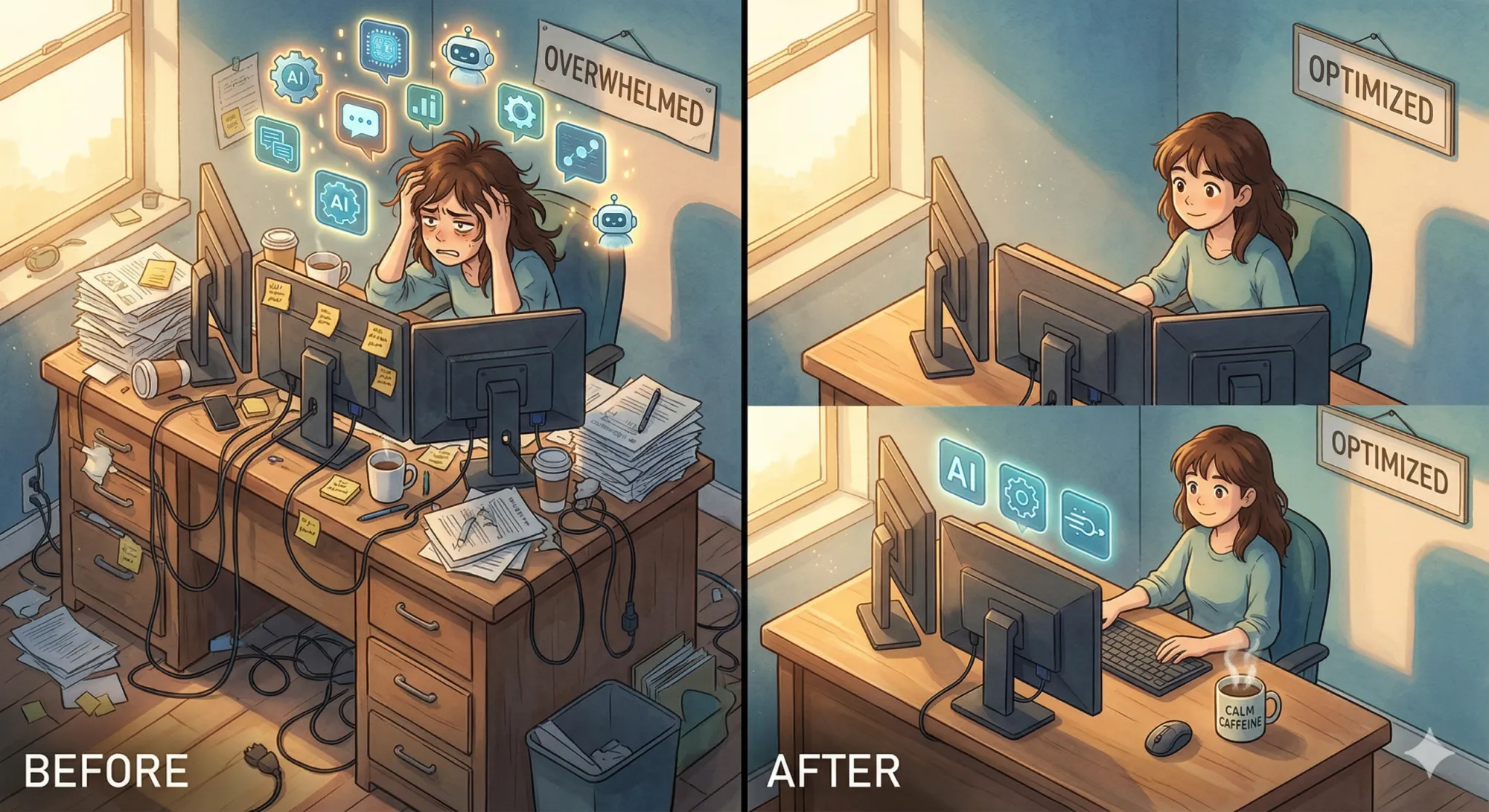
This is the core principle inside the TSP Method. It’s not anti-AI. It’s anti-noise.
The F.A.K.E. Framework: Your AI Filter
Here’s the question you’re probably not asking before you open Claude, ChatGPT, or Gemini:
Should this task even exist?
AI is exceptional at execution. It has zero opinion about whether something should be executed. That’s still your job. And the F.A.K.E. Framework is how you do it.
Before any task gets AI treatment, run it through four filters:
| Filter | Question to ask |
|---|---|
| 🎯 F – Focus | Does this move my #1 priority this week? |
| ✨ A – Alignment | Does this serve my North Star, and/or my values? |
| 👨🎓 K – Knowledge | Can I actually learn from this AI output? |
| 🔋 E – Energy | Do I have the right energy state for this right now? |
The rule:
If a task fails 2 or more filters → delete it. Not automate it.
“Vibe coding” by someone who can’t judge the output is just technical debt with extra steps.
AI-writing by someone who can’t tell if the voice sounds right is brand erosion at scale.
The K filter alone eliminates a massive swath of AI-assisted busywork.
One software engineer described it directly: “The paradox is that the more capability you have, the more you feel compelled to use it. The more you use it, the more fragmented your attention becomes. The more fragmented your attention, the less you actually ship.”
The F.A.K.E. Framework is the antidote to that trap.
It’s Essentialism, Greg McKeown’s “disciplined pursuit of less”, applied to the AI era. AI raises the stakes of that principle. It doesn’t change it. 7
You can find the full F.A.K.E. Framework breakdown here.
What a Sustainable AI Workflow Actually Looks Like
Here’s the practical application, the weekly rhythm you can adapt inside the TSP Flow System and inside your daily work:
- Deep Work blocks. Strategic AI use only after ideas → frameworks, nothing operational.
- Execution mode blocks. AI for amplification of thinking you’ve already done. Not a substitute for it.
- Review your week + delete unnecessary AI-generated tasks that crept in. Be ruthless.
- Analog blocks. No prompting. Let your prefrontal cortex recover.
The principle is simple: protect deep thinking first, then use AI to scale the output of that thinking.
If your AI output is garbage, it’s because your thinking input was empty. AI amplifies what you bring to it. It doesn’t replace the bringing.
The Real Skill of 2026
Deloitte’s 2025 Workforce Intelligence Report found that “mental fatigue, cognitive strain and decision friction are now the leading indicators of burnout, surpassing workload volume for the first time.”
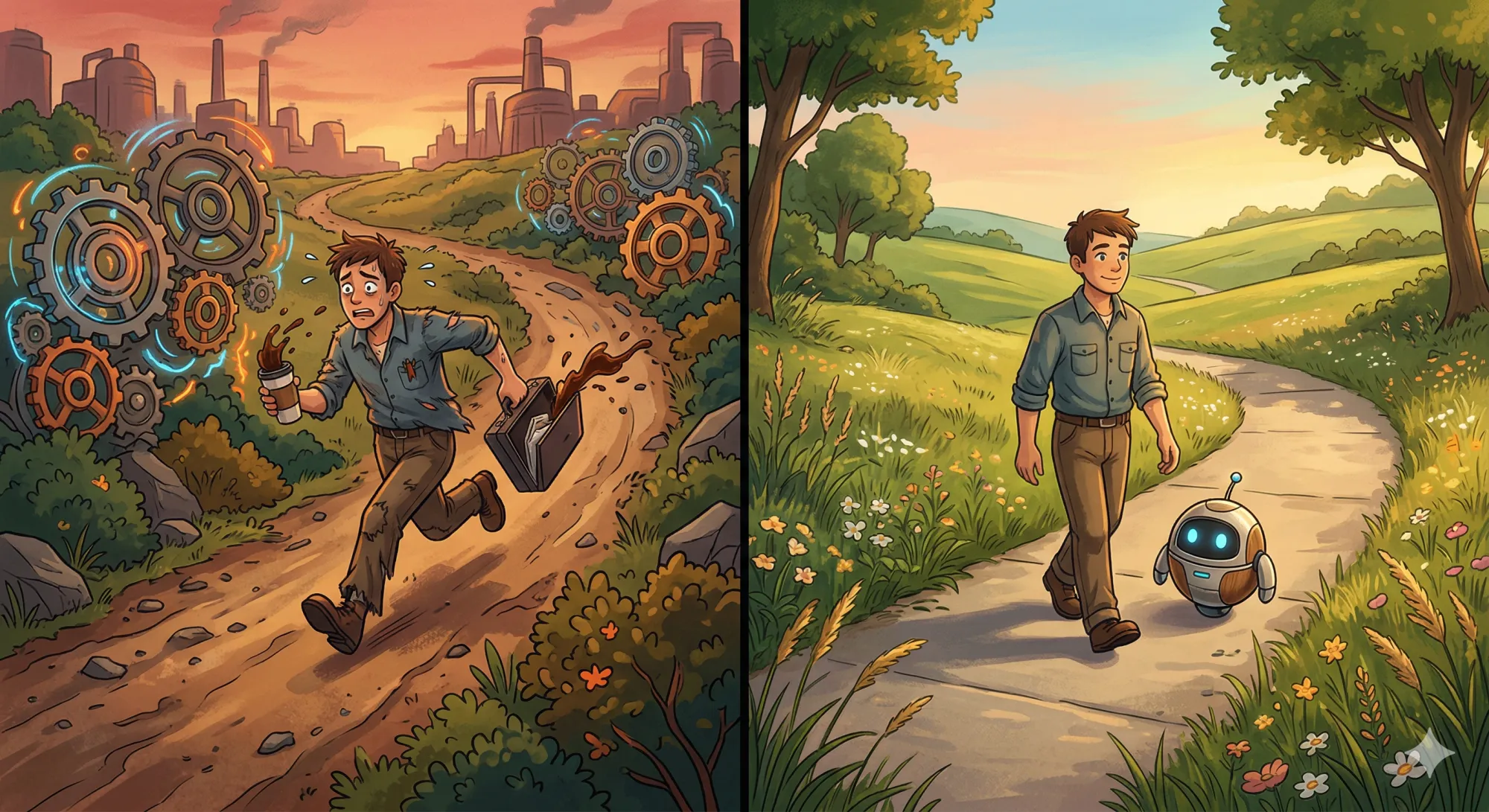
The premium skill of 2026 isn’t writing better prompts. It’s selective inaction, the disciplined ability to say no to tasks that AI makes artificially easy to do.
That second question: Should this even be done? It is worth more than any prompt engineering course you’ll ever take.
This article is a co-creation of Erick Stoic with Claude (Anthropic) and Nano Banana 🍌.
Want the Full System?
I’ve put together a free F.A.K.E. Framework checklist you can use before your next planning session, grab it at ‘The F.A.K.E. Framework: A Human Alternative to SMART Goals for 2026’.
If you want the complete workflow, the AI stack audit, the Flow-First weekly rhythm, and the TSP Method templates, the Productivity Nirvana Community and Online Course is all of it in one place. But start with the free checklist first. Build the filter habit before you build the system.
📌 Found this useful? Save it for your next AI tool audit.
🔁 Share it with a colleague who’s drowning in AI tasks.
👤 Connect/Follow me (Erick Stoic) on LinkedIn for weekly no-BS productivity analysis.
🌐 Join the community:thesustainableproductivity.com
Recommended Reading
📖 The F.A.K.E. Framework: A Human Alternative to SMART Goals for 2026
The full breakdown of Focus · Alignment · Knowledge · Energy; and how to use it as your weekly filter before touching any AI tool.
FAQ
What is AI brain fry?
AI brain fry is mental fatigue caused by excessive use or oversight of AI tools beyond your cognitive capacity.
Symptoms include slower decision-making, mental fog, more errors, and an inability to disconnect from work.
The term was coined by Boston Consulting Group researchers in a 2026 Harvard Business Review study of 1,488 workers.
Why are the biggest AI users experiencing the most burnout?
Because AI expands what feels possible, workers voluntarily take on more tasks, broader roles, and longer hours.
The tools create capacity; organisations and individuals fill it.
The result is more work at the same cognitive bandwidth, a recipe for AI burnout.
How many AI tools should I use at once?
BCG’s research found productivity peaks at three tools and drops sharply beyond that.
The recommendation from the TSP Method: use the F.A.K.E. Framework to audit your stack and keep only tools that earn their place.
What is the F.A.K.E. Framework?
A four-filter decision tool for AI tasks:
- Focus (does this move my top priority?)
- Alignment (does this serve my North Star and/or my values?)
- Knowledge (can I learn from this output?)
- Energy (do I have the right energy state?).
If a task fails two or more filters, delete it, don’t automate it.
Is the solution to use less AI?
Not exactly. The solution is to filter before using AI, not after.
Use AI with intention, not reflex. Protect your deep thinking block, use AI to amplify what you’ve already thought through, and audit your stack regularly.
References & Further Reading
- Ranganathan, A. & Ye, X.M. (2026, February 9). AI Doesn’t Reduce Work — It Intensifies It. Harvard Business Review. https://hbr.org/2026/02/ai-doesnt-reduce-work-it-intensifies-it
- Zahn, M. (2026, February 10). In the workforce, AI is having the opposite effect it was supposed to, UC Berkeley researchers warn. Fortune. https://fortune.com/2026/02/10/ai-future-of-work-white-collar-employees-technology-productivity-burnout-research-uc-berkeley/
- Bedard, J., Kropp, M., Hsu, M., Karaman, O.T., Hawes, J. & Kellerman, G.R. (2026, March 5). When Using AI Leads to “Brain Fry.” Harvard Business Review. https://hbr.org/2026/03/when-using-ai-leads-to-brain-fry
- Ferris, R. (2026, March 10). ‘AI brain fry’ is real — and it’s making workers more exhausted, not more productive. Fortune. https://fortune.com/2026/03/10/ai-brain-fry-workplace-productivity-bcg-study/
- Coldewey, D. (2026, February 10). The first signs of burnout are coming from the people who embrace AI the most. TechCrunch. https://techcrunch.com/2026/02/09/the-first-signs-of-burnout-are-coming-from-the-people-who-embrace-ai-the-most/
- CBS News (2026). Is AI productivity prompting burnout? Study finds new pattern of “AI brain fry.”https://www.cbsnews.com/news/is-ai-productivity-prompting-burnout-study-finds-new-pattern-of-ai-brain-fry/
- McKeown, G. (2014). Essentialism: The Disciplined Pursuit of Less. Crown Business.