

Two people on your team gave the same task to an AI last week. They got two different answers, built to two different standards. Both shipped.
Nobody did anything wrong, and that's the uncomfortable part. Each had a decent prompt. What they didn't have was a shared answer to two questions:
- what does good look like here?
- and, who signs it?
The short answer: a team working agreement for AI has five parts.
- A goal,
- guardrails,
- validation owners,
- work-in-progress (WIP) limits,
- and, kill criteria.
Every rule is numbered and dated, and the page loads wherever the work happens.
A prompt tells the AI what to do today. The agreement tells everyone, human and machine, how this team works.
Why do shared prompts not scale across a team?
Shared prompts don't scale because a prompt holds a request, not a decision.
It says what you want right now. It says nothing about what the team already learned, what it refuses to do, or who checks the result.
So every session starts from zero. A prompt is disposable. A rule compounds.
Rules on paper aren't enough either. The EY AI Risk and Governance Survey (Ernst & Young LLP, September 15, 2026) asked 202 senior AI decision-makers at US public companies with at least $1 billion in revenue.
98% said they have formal AI governance policies in place.
And 47% said their organization has, at some point, not applied its own governance process to an urgent deployment.
Those are billion-dollar companies, not your squad. But the pattern travels.
A rule that lives in a policy document loses to a deadline.
A rule that loads where the work happens has a chance. It's one more reason velocity stopped being the edge.
What is a team working agreement for AI?
A team working agreement for AI is a short, written set of numbered and dated rules that says how a team and its AI tools work together:
- what the work is for,
- what the AI may never do,
- who validates which output,
- how much runs at once,
- and, when something gets switched off.
If you've run agile teams, you know the format. The AI version adds one thing: the AI reads it too.
That's how I run my own system across two businesses. Every decision we make once goes into a numbered, dated file that loads at the start of every session, so the next session inherits the judgment instead of improvising it.
In the TSP Method this is the A in LEAF: Alignment. For a person, the question is "does this fit the person I want to be?"
For a team, it becomes "does this fit the team we said we want to be?"
What goes in one?
Five sections on one page is one of the good practices.
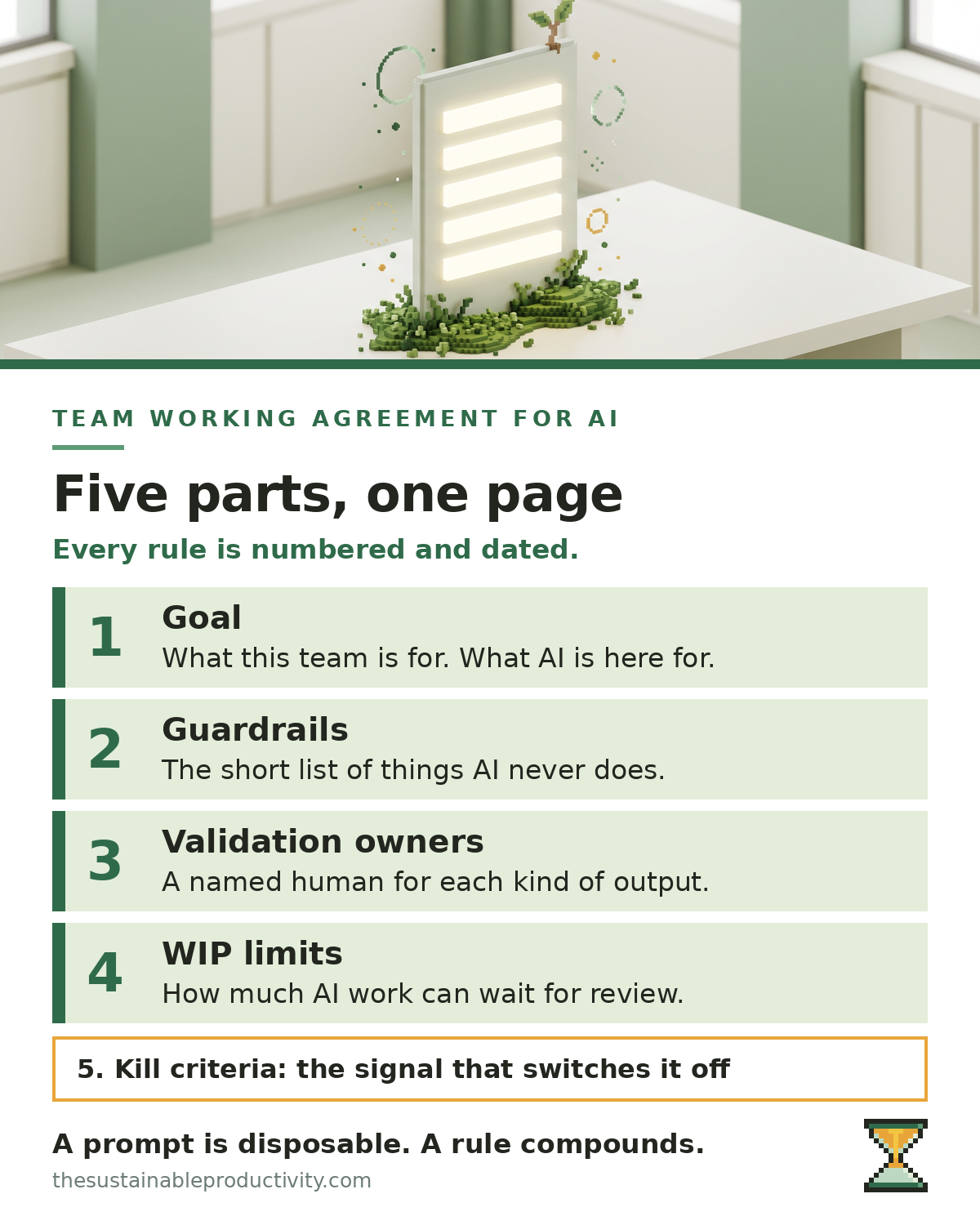
- Goal. One or two lines on what this team is for and what AI is here to help with.
- Guardrails. The short list of things AI never does here. For example: never sends anything to a customer, never invents a number.
- Validation owners. A named human for each kind of output. Not "the team reviews it". One person signs.
- WIP limits. How much AI work can wait for review at once. In my own system there's a hard cap of three drafts waiting. Draft supply was never the bottleneck. My energy to review was.
- Kill criteria. The signal that switches a rule, an agent or an automation off. For example: nobody used the output in two weeks.
Write each rule as one sentence with a number and a date.
The number lets people point at it.
The date tells you how old the thinking is.
Not sure a task deserves automating at all? Run it through the four LEAF questions first.
Human in the loop or human on the loop: which checkpoint goes where?
Put a human in the loop where a mistake is hard to undo, and on the loop where it's cheap to undo.
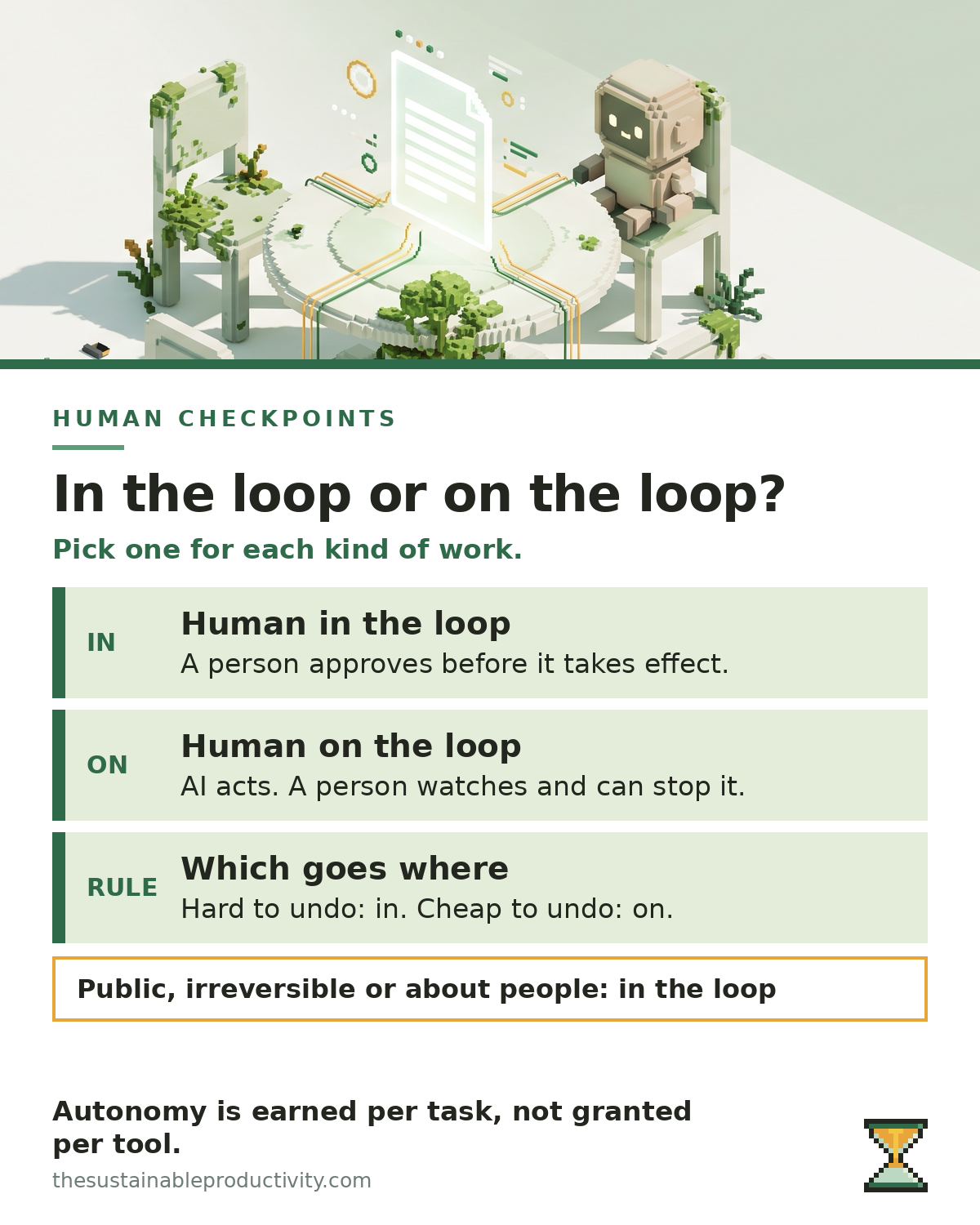
- Human in the loop: the AI prepares, and a person approves before anything takes effect.
- Human on the loop: the AI acts on its own, and a person watches the results and can stop it.
Anything public, irreversible or about people stays in the loop.
In my own setup nothing publishes without my yes on each item. The AI drafts. I sign. Start there, then move one kind of work at a time on the loop as it earns trust. Autonomy is earned per task, not granted per tool.
In the same EY survey, 85% of respondents whose organization uses agentic AI said at least a handful of those systems execute actions without real-time human involvement.
How do you write the first version in one hour?
You write it with the team, in one timeboxed session, and you keep it ugly.
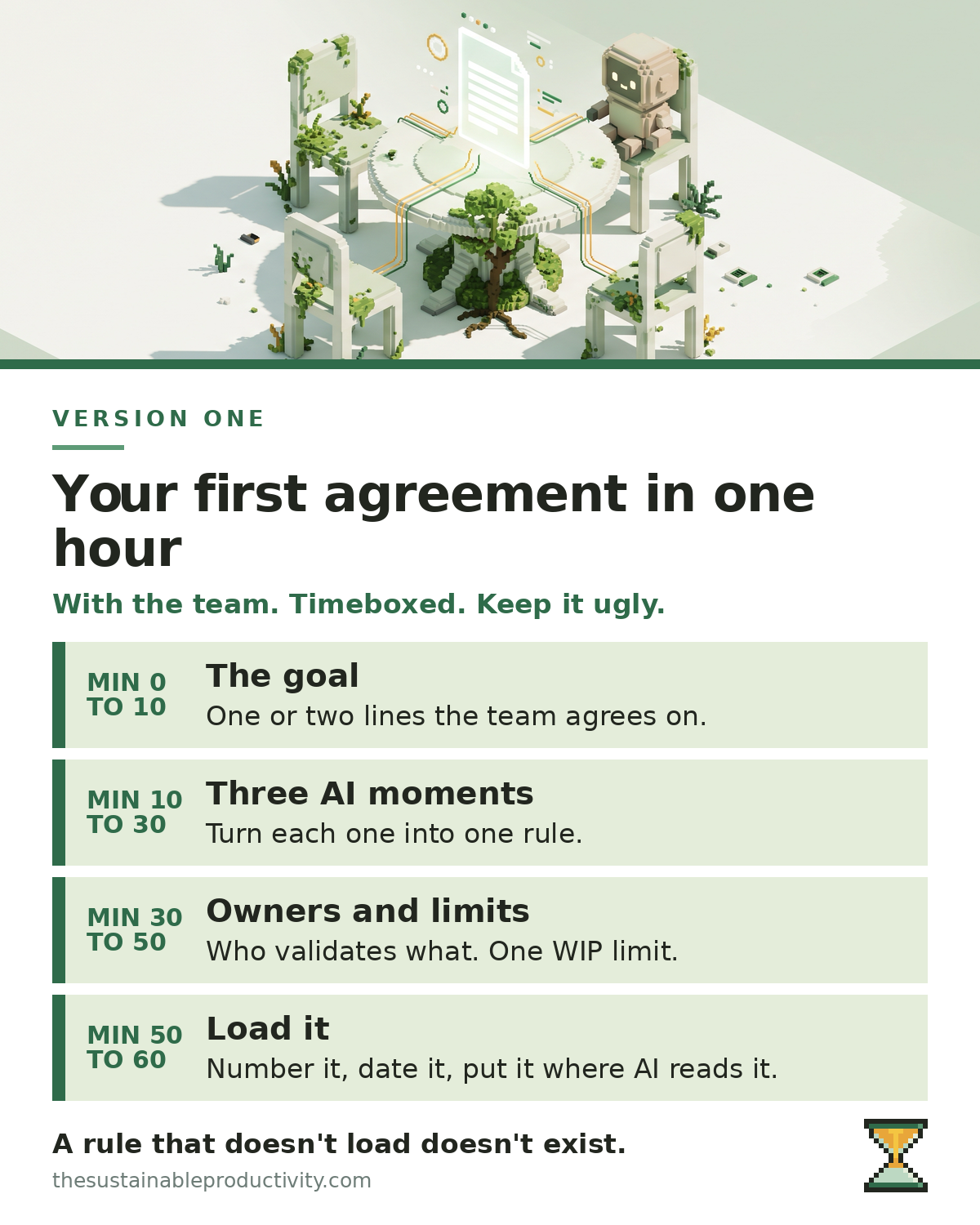
- Minutes 0 to 10: the goal. One or two lines the team agrees on. If you can't agree, that's your real finding.
- Minutes 10 to 30: three AI moments. One that went well, one that went wrong, one that confused everyone. Turn each one into one rule.
- Minutes 30 to 50: owners and limits. Name who validates what, pick in the loop or on the loop for each kind of work, and set one WIP limit.
- Minutes 50 to 60: load it. Number it, date it, and put it where the AI reads it at the start of a session.
Five to eight rules is plenty for version one. Keep the page next to your board, where priorities and workload are already visible to everyone.
How do you keep it alive?
You keep it alive with the delete test. If I deleted today's conversation, would the system still know what it learned today? If not, it didn't learn. It performed 🎭
So when a session teaches you something, one rule gets added, changed or removed before you close the laptop.
And check that the rules actually load. I once found a rule that had existed for almost two months and wasn't reaching the sessions that needed it. A rule that doesn't load doesn't exist.
Then test the agreement itself. In TSP every method is a hypothesis with a 14-day loop:
- Hypothesis: "If our rules load before our prompts, we redo less AI work."
- Day 0: count the AI outputs that were sent back or redone last week.
- Days 1 to 14: the agreement loads in every session.
- Day 14: count again. Keep it, adapt it or drop it.
What rule does the agreement itself have to obey?
Health.
An agreement that only works if people are available at all hours fails the audit.
If every agent needs human approval at 11 pm, you didn't design a checkpoint.
You designed an on-call rota nobody agreed to.
Give approvals a review window, and let the work wait for it.
FAQ: team working agreements for AI
Is a team working agreement the same as AI governance?
No. AI governance is the organization's layer: policy, risk, compliance and audit. A team working agreement is the team's layer: the daily rules for how this group and its AI tools work. It fits inside your company's governance and never replaces it.
Can I use a working agreement for AI if I work alone?
Yes. Same five sections, with your name as the only validation owner. It matters even more alone, because nobody else will catch what you skip.
I co-created this article with Claude (Anthropic) and Nano Banana 🍌, who generated the images/infographics.
Your next steps: choose one
Leading a team whose AI work has no shared rules yet?
Book the free 45-minute flow diagnostic. We map your real context and you leave with one mapped flow leak.
Building your own way of working with AI and running low on energy?
That's what we fix in TSP Premium Mentorship: 12 weeks of 1:1 work on your real context and your real bottlenecks.
Grow your work. Don't grind it.
The full system lives in The Sustainable Productivity Method Online Course.