
You shipped more this week than you used to ship in a month. So why does Friday feel like you lost?
You're not slow. You're fast, and the speed is running you. That's the problem sustainable productivity solves.
What is Sustainable Productivity?
Sustainable productivity is the practice of doing meaningful work at a pace you can keep for years.
You manage energy instead of time, run small experiments instead of big resolutions, and treat sleep, movement and recovery as non-negotiable.
The test is simple: can you still do good work, and enjoy it, five years from now?
I'm Erick Stoic, and that definition is the backbone of The Sustainable Productivity (TSP) Method. I call it the antidote to AI velocity.
Doing everything became cheap.
Deciding what deserves doing became the real work.
Why does the usual productivity advice fail?
The usual productivity advice fails because it treats speed as the fix, and speed is no longer the bottleneck.
More tools. Tighter systems. Earlier alarms. All of it assumes your problem is that you're not doing enough.
The data says otherwise. In the Lenny's Newsletter Tech Worker Sentiment Survey (Noam Segal and Lenny Rachitsky, July 7, 2026), 82% of respondents said AI is already making them at least moderately better at their job.
In the same survey, significant burnout rose from 44.7% to 55.7% in one year. People got more capable and more exhausted at the same time.
UC Berkeley researchers Aruna Ranganathan and Xingqi Maggie Ye watched the mechanism up close.
In Harvard Business Review (February 9, 2026), they reported that with AI tools "employees worked at a faster pace, took on a broader scope of tasks, and extended work into more hours of the day, often without being asked to do so."
Nobody forced it. The work expanded to fill the new capacity.
When execution gets cheap, the scarce resource isn't time. It's your energy and your judgment.
Advice that only makes you faster makes this worse.
I called the early signs the over-optimization backlash, and I wrote about where it ends in AI Brain Fry: why the people using AI the most are the most burned out.
What is Sustainable Productivity not?
Sustainable productivity is not slow work, anti-AI work, or doing less for its own sake.
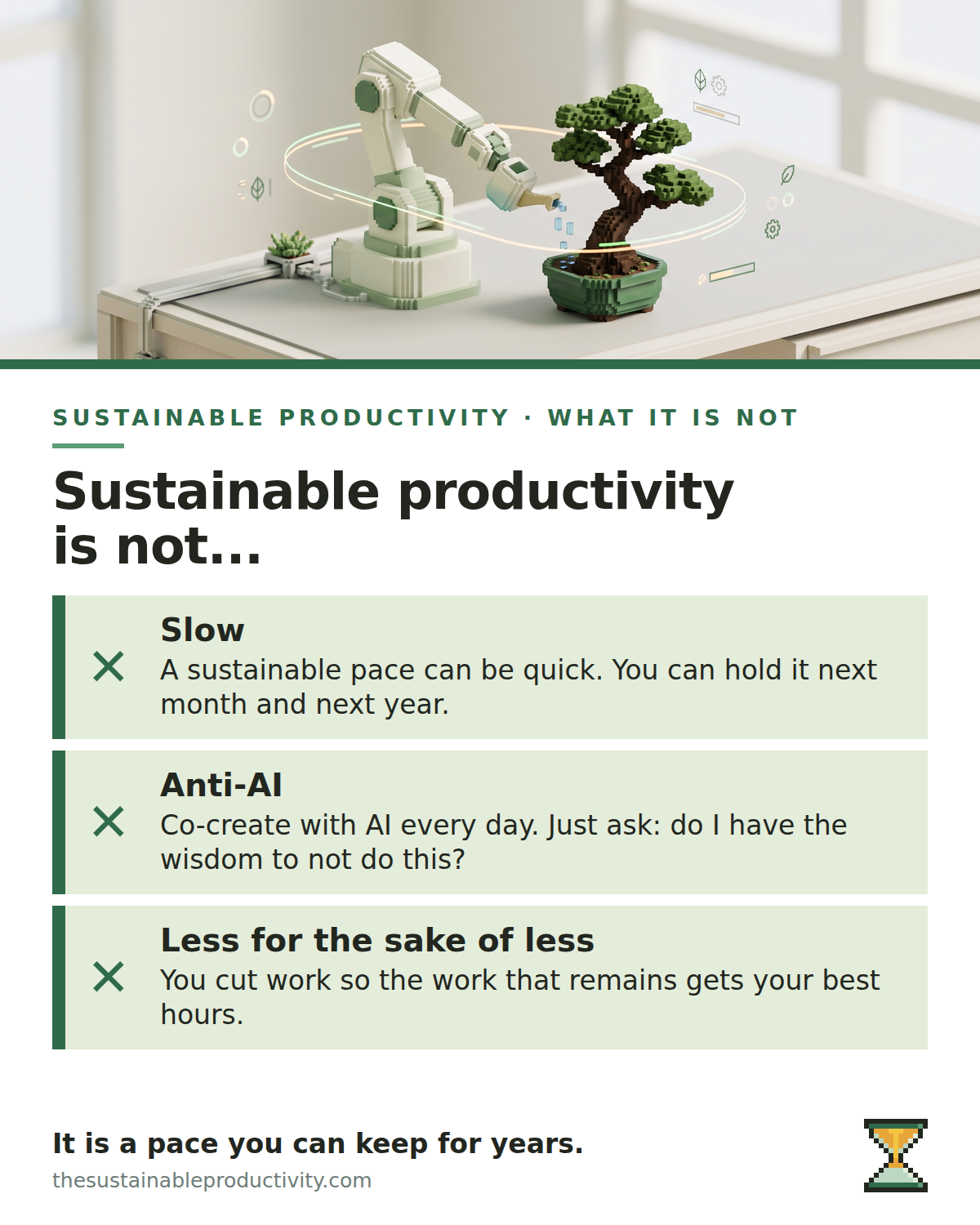
- It's not slow. A sustainable pace can be quick. The difference is that you can hold it next month and next year.
- It's not anti-AI. I co-create with AI every day. The question just changed, from "how do I get this done?" to "do I have the wisdom to not do this, even though AI makes it easy?"
- It's not less for the sake of less. You cut work so the work that remains gets your best hours.
For the longer argument on why presence beats raw speed, read The Antidote to AI Velocity.
What is the LEAF Framework?
LEAF is the filter of the TSP Method: four questions you run any task, goal or commitment through before you spend energy on it. LEAF stands for Learning, Energy, Alignment and Focus.
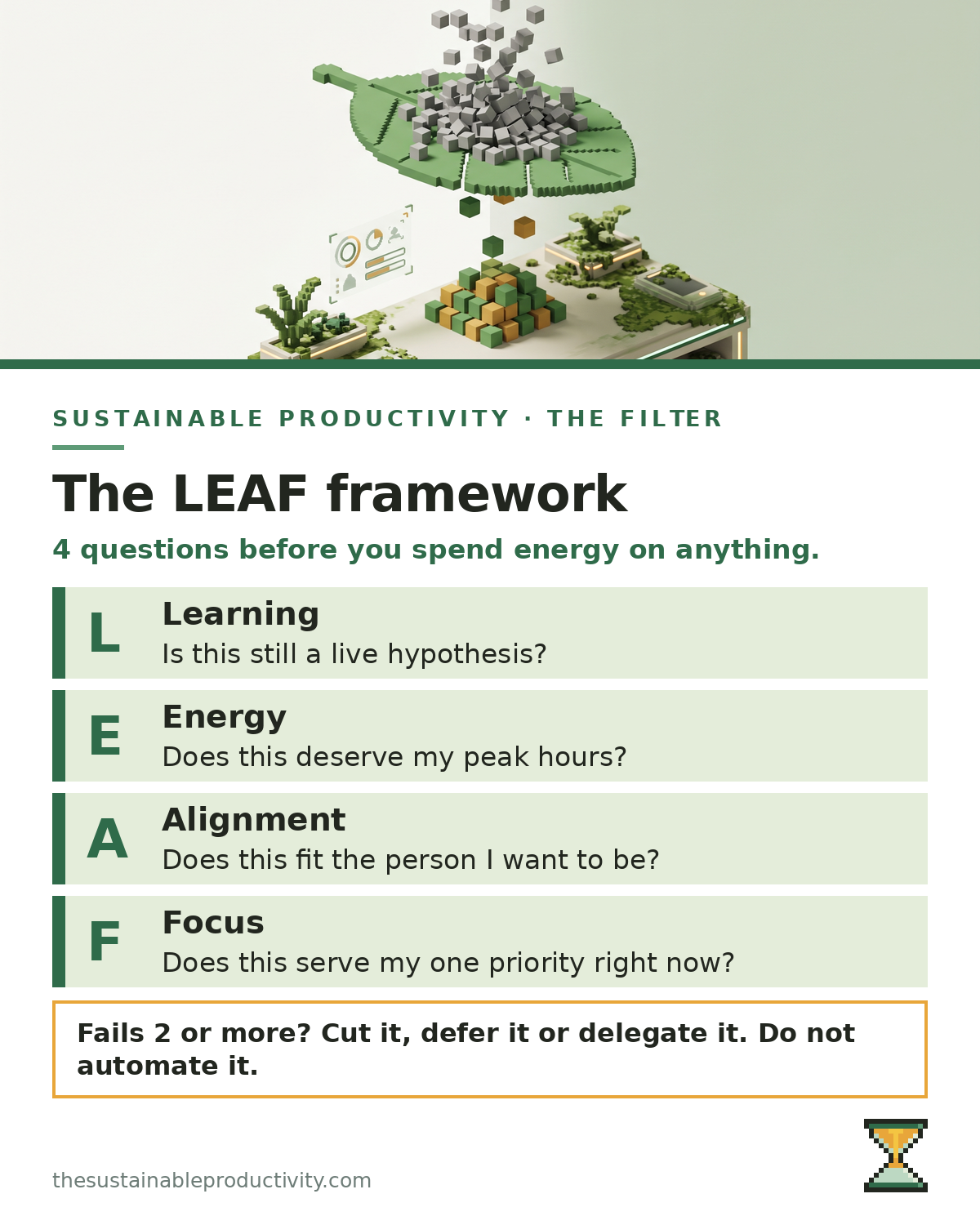
- L is for Learning. Is this still a live hypothesis? Study in small batches and treat every method as an experiment in a 14-day loop.
- E is for Energy. Does this deserve my peak hours? Manage energy, not time, and match your hardest work to the window when you're sharpest.
- A is for Alignment. Does this fit the person I want to be? Every 'yes' is a vote for an identity.
- F is for Focus. Does this serve my one priority right now? One north star, tied to an experiment that can prove it wrong.
The rule: if a task fails two or more pillars, cut it, defer it or delegate it. Do not automate it.
Automating work that shouldn't exist only produces waste faster.
LEAF is the evolution of my older F.A.K.E. framework, which stays online as historical context.
One boundary: LEAF sorts work, not people. It's a filter, never a diagnosis.
What are the 4 TSP Power-ups?
The 4 TSP Power-ups are the core values of the TSP Method: the habits that make a pace sustainable.
LEAF decides what you work on.
The Power-ups decide how you work.
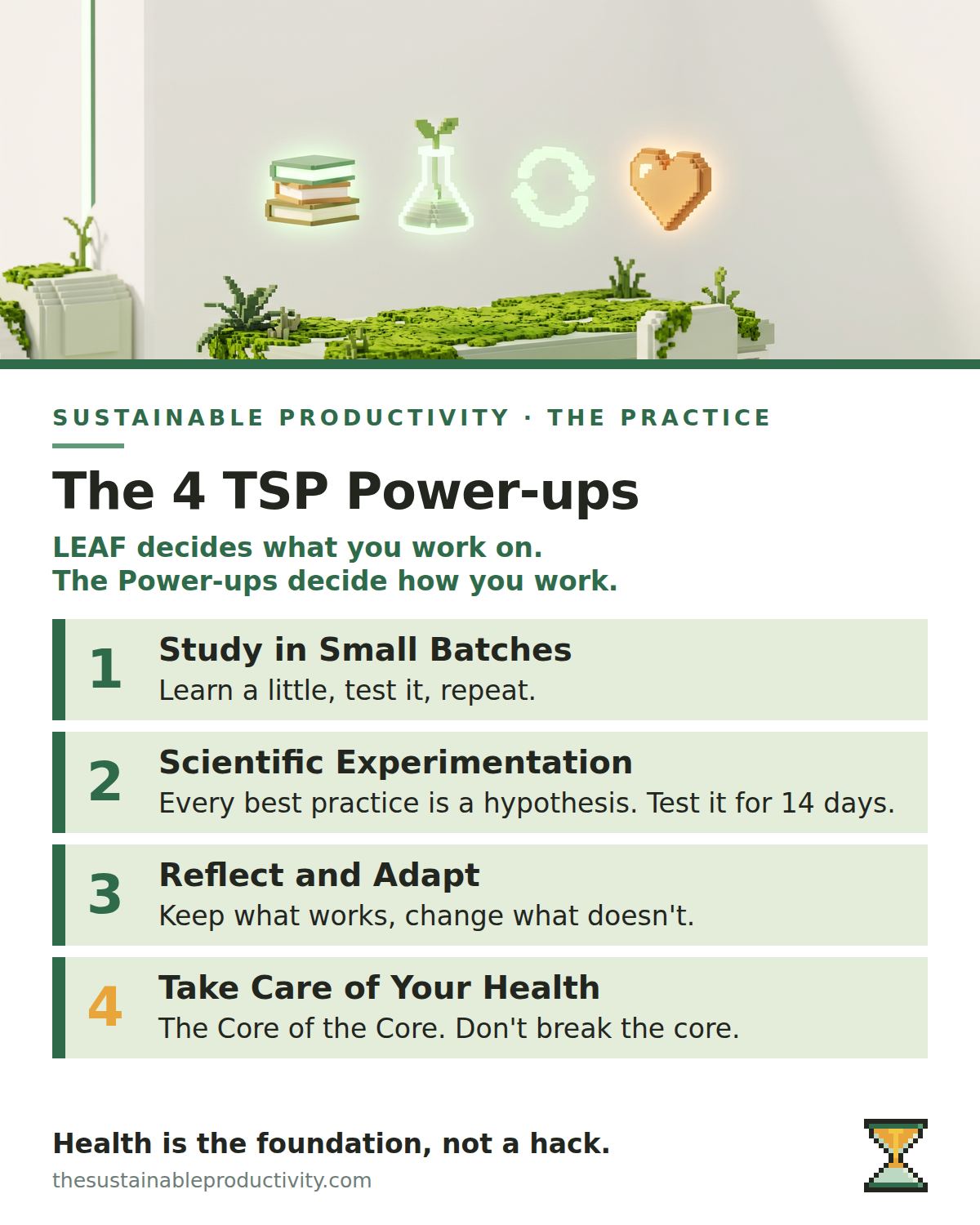
- Study in Small Batches. "I know that I know nothing." There will always be more to learn, so learn a little, test it, repeat. Skip the perfect system.
- Scientific Experimentation. Every best practice is a hypothesis. Give it a shot for 14 days and see if it suits your needs.
- Reflect and Adapt. If it didn't go to plan, that's data. Keep what works, change what doesn't, run the loop again.
- Take Care of Your Health. This is the Core of the Core, the value the other three stand on. The motto is "don't break the core":
- Protect your sleep
- Move every day: workout, stretch, just a 30-min walk per day counts
- Book ~15-min strategic breaks in your own agenda: no screens.
- Periodically book a consult with healthcare professionals
- Eat healthy most of the week
Any goal that costs you sleep, movement, or recovery fails the TSP audit, however good it looks on a roadmap.
Health isn't a productivity hack. It's the foundation everything else runs on.
How do you start practicing Sustainable Productivity?
Start with one 14-day experiment, not a new life. Here's the protocol I'd run in a hybrid work week:
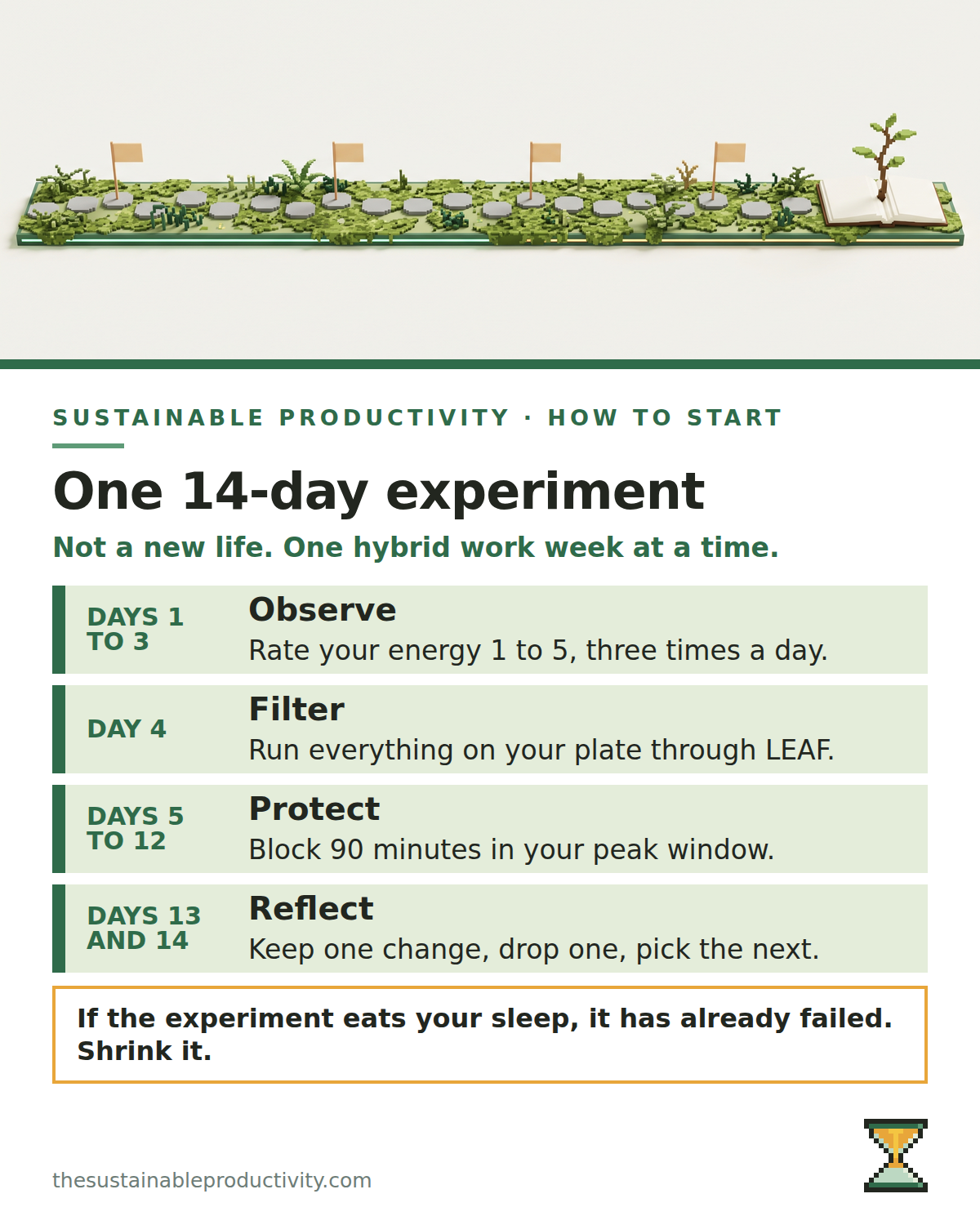
- Days 1 to 3: observe. Three times a day, rate your energy from 1 to 5 in a note. Change nothing yet. You're finding your peak window.
- Day 4: filter. List everything on your plate and run each item through LEAF. Anything that fails two or more pillars gets cut, deferred or delegated.
- Days 5 to 12: protect. Block 90 minutes in your peak window for your one priority. On office days, book a room. On home days, close chat. Pick one evening shutdown time and keep it.
- Days 13 and 14: reflect. What worked? What didn't? Keep one change, drop one, and choose the next hypothesis.
One guardrail from Power-up 4: if the experiment itself starts eating your sleep, it has already failed. Shrink it.
Sustainable Productivity FAQ
Is Sustainable Productivity just doing less?
No. Sustainable Productivity is doing the right work at a pace you can hold for years.
Sometimes that means doing less.
Often it means the same amount of work with fewer open loops and real recovery.
How is sustainable productivity different from hustle culture?
Hustle culture measures hours and output this week.
Sustainable Productivity measures whether you can still produce good work next year.
One optimizes for speed, the other for energy, health and judgment.
Does sustainable productivity work with AI tools?
Yes. Sustainable Productivity is pro-AI and pro-filter.
Use the LEAF framework to decide what deserves doing, then let AI help with the work that passes.
The risk is real: researchers writing in Harvard Business Review (Bedard and colleagues, March 5, 2026) describe "brain fry" as mental fatigue from excessive use or oversight of AI tools beyond one's cognitive capacity.
A filter keeps the amount of AI output you have to oversee at a human scale.
How long does it take to see results?
Give one experiment 14 days. That's long enough to see a pattern and short enough to drop without guilt.
No practice works for everyone, which is why every TSP practice is a hypothesis, not a rule.
Who is Sustainable Productivity for?
Sustainable Productivity is for anyone losing their day to context-switching and a pace they can't keep, whatever the reason:
- product people
- developers
- designers
- hybrid and remote professionals
It's a way of working, not medical advice.
If exhaustion persists after you've protected sleep and cut load, that's worth taking to a healthcare professional. I am not one.
Your next step: if you're a builder who wants a guide for the first 12 weeks, TSP Premium Mentorship is where I work 1:1 with you on your energy, your priorities and your pace.
The Sustainable Productivity Method. Grow your work. Don't grind it. The online course live at thesustainableproductivity.com.
This article is a co-creation with Claude (Anthropic), Nano Banana 🍌 and me ( Erick Stoic ).