

It's Monday. You open the laptop to 340 unread messages, a board full of stale tickets and three half-finished docs.
And for the first time in your career, a machine can clear most of it in an hour.
So why does that feel like relief and dread at the same time?
Because part of you knows half of that pile shouldn't exist. And once you automate it, it gets to live forever.
The short answer: automate only the work that survives a filter.
Before you hand anything to AI, ask four questions.
- Is the reason behind this still true?
- Is the result worth the energy?
- Does it fit who I want to be?
- Does it serve my one priority?
Work that fails two or more gets cut, deferred or handed to a person. It does not get automated.
Why is automating everything a trap?
Automating everything is a trap because your backlog is not a to-do list. It's a queue of unmade decisions.
Every item in there is a question nobody answered. Do we still need this? Is it mine? AI doesn't answer those questions. It executes the item as if the answer were 'yes'.
The usual advice says "list your repetitive tasks and automate them". But repetitive is not the same as worth doing.
Automate a weekly report nobody reads and you get a weekly report nobody reads, plus, a workflow to maintain.
Someone pays for that, usually downstream.
BetterUp Labs and the Stanford Social Media Lab named it workslop: AI output that looks like good work but lacks the substance to move the task forward.
In their survey of 1,150 full-time US desk workers (Harvard Business Review, September 2025), 40% had received workslop in the past month, and each instance took about two hours to sort out.
The speed isn't making people feel better either.
In the Lenny's Newsletter Tech Worker Sentiment Survey (Noam Segal and Lenny Rachitsky, July 7, 2026), significant burnout rose from 44.7% to 55.7% in one year.
The top AI fear wasn't losing the job (22%). It was being expected to do more for the same pay (51%) and getting trapped in an unsustainable pace (46%).
AI made executing cheap. That makes deciding nothing expensive.
I've written before about why velocity stopped being the advantage. Automating an unfiltered backlog is how you build that unsustainable pace with your own hands.
What is the LEAF filter?
LEAF is the filter inside The Sustainable Productivity (TSP) Method: four questions you ask about a piece of work before you do it, delegate it or automate it.
The letters stand for Learning, Energy, Alignment and Focus.

- Learning
- Is the reason behind this still true?
- Can I learn with this experiment/delivery?
- Every task started as a guess that it would be useful. Is that guess still alive, or did it quietly die months ago?
- Energy
- Is the result worth the energy it costs?
- Count everyone's energy. Yours, and whoever has to read, review or fix the output.
- Alignment
- Does it fit who you want to be?
- The role you're growing into, the work you want to be known for.
- Focus
- Does it serve your one priority right now?
- One north star for the week. Not five.
The rule is simple. If an item fails two or more questions: cut it, defer it or delegate it to a person it fits better. Do not automate it.
An automated task keeps running, keeps producing output, and someone has to check it and fix it when it breaks.
How do I run my backlog through LEAF in 15 minutes?
You run it as a timed triage, not as a planning session. Here's the version that fits a real hybrid week:
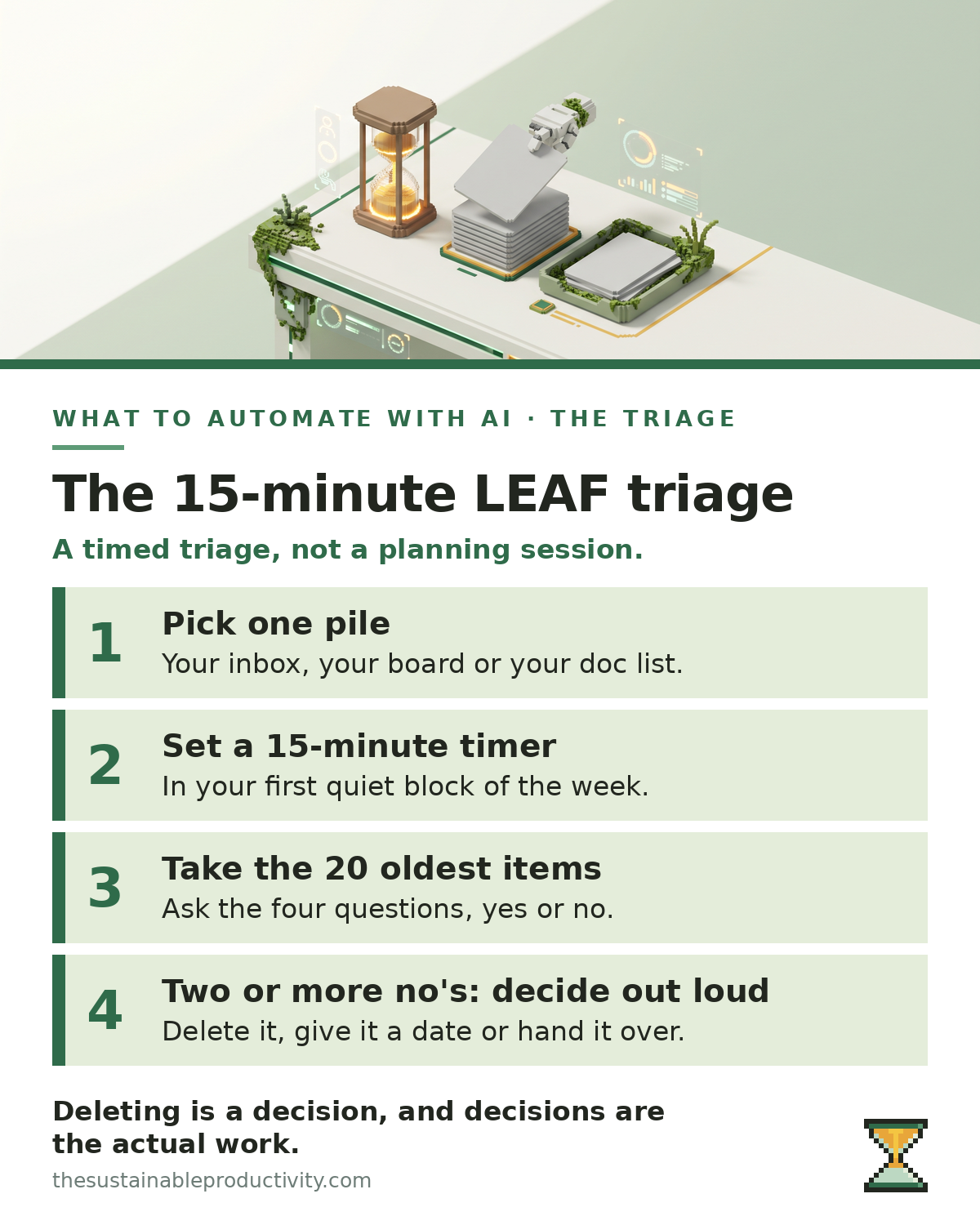
- Pick one pile. Your inbox, your board or your doc list. One, not all three.
- Set a 15-minute timer in your first quiet block of the week, before you open chat.
- Take the 20 oldest items. Old items are where the dead decisions hide.
- Ask the four questions, yes or no. A few seconds each. If you need a meeting to answer, that's a no for now.
- Two or more no's: decide out loud. Delete or archive it, give it a date, or hand it to someone it fits better.
What's left is your real work.
Leading a team? Same questions, different unit: run them on the team board in your weekly planning and say the fails out loud.
What should I hand to AI after filtering, and with which guardrails?
Hand AI the survivors that drain you: repetitive, well-defined and easy to check.
Keep the survivors that need your judgment.
And hand them over generously. I'm not telling you to use AI less.
After the filter, I want AI doing more of my backlog, not less. The waste was never AI doing the work. It was nobody deciding what deserved doing.
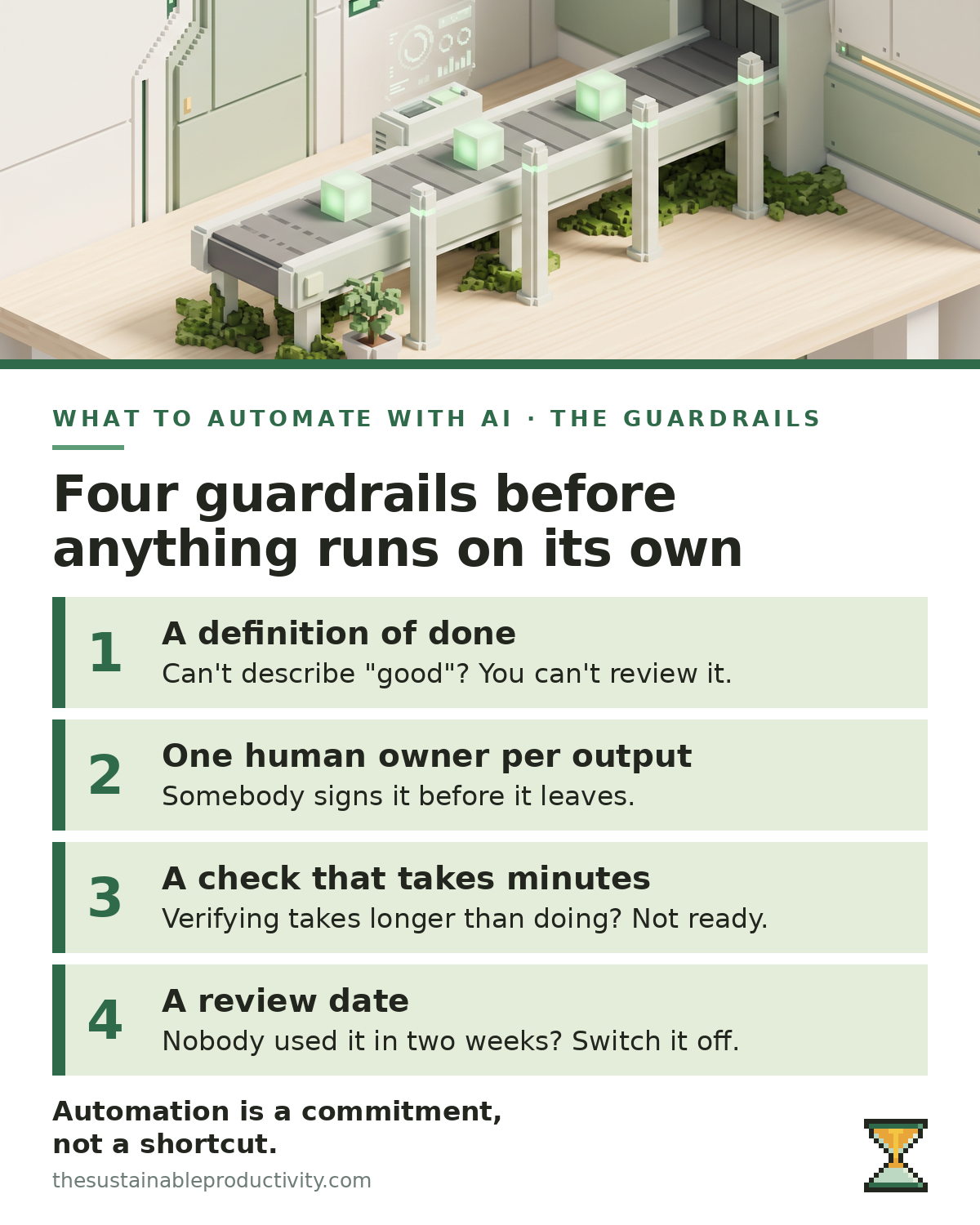
Four guardrails before anything runs on its own:
- A definition of done. If you can't describe "good", you can't review it.
- One human owner per output. Somebody signs it before it leaves the building.
- A check that takes minutes. If verifying takes longer than doing, it's not ready to delegate.
- A review date. If nobody used the output in two weeks, switch it off.
It's the same logic behind the 3-Tool Rule, where I cut my AI stack from 11 tools to 3.
How do I test this for 14 days?
You treat it as an experiment, not as a new religion.
In TSP every method is a hypothesis with a 14-day loop.
- Hypothesis: "If I filter before I automate, I end the week with fewer open items and more energy left."
- Day 0: count the open items in one pile. Rate your end-of-day energy from 1 to 5.
- Days 1 to 14: one 15-minute LEAF triage every Monday and Thursday. Nothing gets automated unless it passed the filter. Log each call in one line: cut, deferred, delegated, automated or kept.
- Every evening: the same 1 to 5 energy score. Ten seconds.
- Day 14: compare the count and the scores. Keep it, adapt it or drop it.
What is the one rule that overrides the filter?
Health overrides the filter.
The TSP Method has four Core Values, and the fourth is the core of the core: take care of your health. Don't break the core.
So any automation that buys speed by costing you sleep, movement or recovery fails the audit, whatever the four answers were.
If babysitting a workflow eats your evening shutdown, it's not saving you anything.
FAQ: what to automate with AI
What tasks should I never automate with AI?
Never automate work that fails two or more LEAF questions, or work where you can't define "done" and check the result in minutes.
Decisions about people, priorities and trade-offs stay human. AI can prepare them, not make them.
How do I decide between delegating to AI and delegating to a person?
Delegate to AI when the work is repetitive, well-defined and quick to verify.
Delegate to a person when it needs context, judgment or a relationship. If it fails the filter, AI is off the table: cut it, defer it or give it to a person it fits better.
Is this an argument against AI?
No. It's an argument for deciding before delegating. Filter sharply, then hand the survivors to AI with clear guardrails and real autonomy.
Your next steps: choose one
- Your own backlog keeps growing no matter how fast you ship? That's what we fix in TSP Premium Mentorship: 12 weeks of 1:1 work on your real context and your real bottlenecks.
- Leading a team that ships faster and decides less? Book the free 45-minute flow diagnostic and we map where the work piles up.
- Grow your work. Don't grind it. The full system lives in The Sustainable Productivity Method Online Course.