
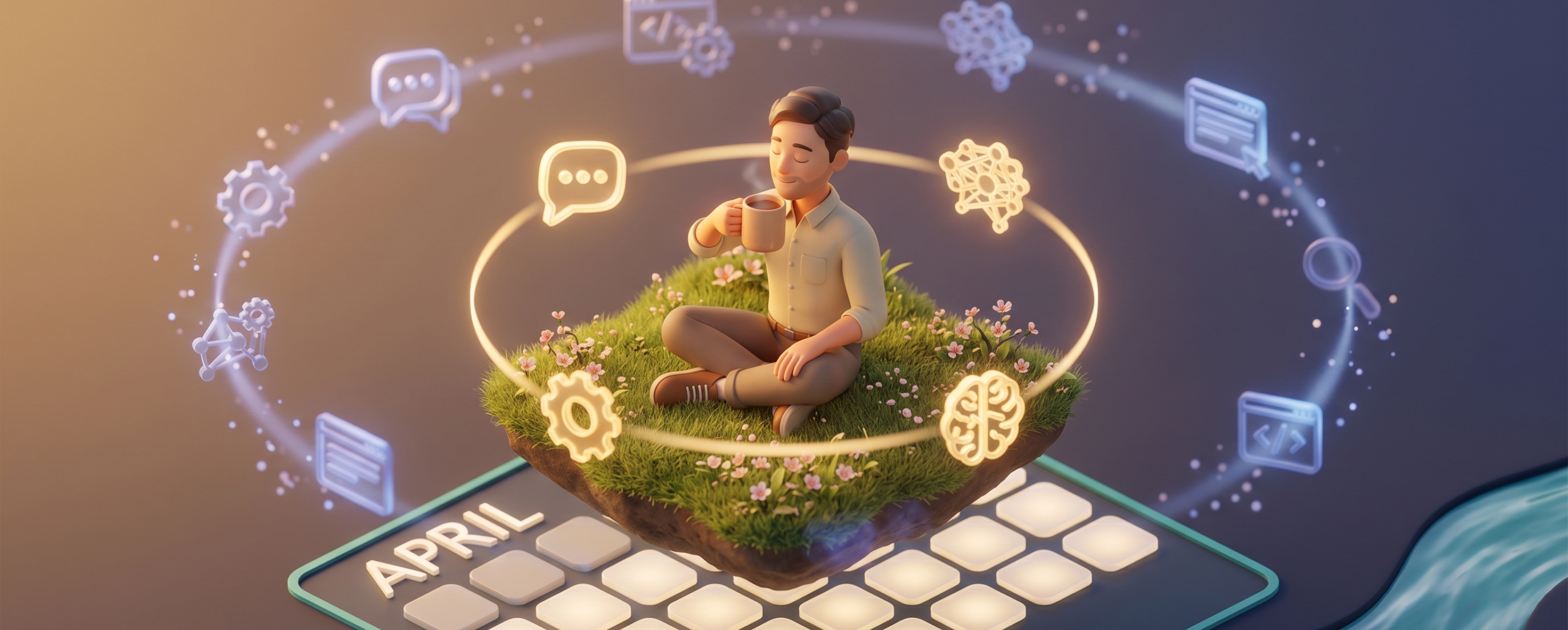
Spent April asking one question I couldn’t shake.
Am I using AI, or is AI using me?
It started in late March. I caught myself opening Perplexity/Gemini/Claude before I’d even finished my coffee. Three tabs. Two prompts already running.
A to-do list that had quietly tripled in size since I “got efficient”.
That’s when I made a decision that felt almost rebellious in the current climate: I was going to spend April running a deliberate slow productivity experiment.
Less velocity. More intentionality. Fewer AI tools. Deeper output.
What follows is the honest reflection. The data, the discomfort, and the framework that earned a permanent seat at my table.

TL;DR / Key Takeaways
- Slow productivity isn’t anti-AI. It’s anti-speed-as-a-strategy. AI Velocity is a drug; slow productivity is the antidote.
- The 4-week arc: Easter Reset → AI Brain Fry diagnosis → F.A.K.E. filter → Flow-First system.
- The honest data: about 30% fewer tasks completed. 100% of the ones that actually mattered. Content quality and engagement both improved.
- What earned permanent residency: the F.A.K.E. Framework, a 3-tool AI stack, and the four TSP Core Values.
What does “slow productivity” actually mean in 2026?
Slow productivity is the deliberate practice of doing fewer things, working at a natural pace, and obsessing over quality, even when AI makes it possible to do more, faster, all the time.
Cal Newport coined the term. The 2026 AI boom turned it from a nice idea into a survival skill.
Here’s why the timing matters. Harvard Business Review published research in February 2026 that put a label on what most knowledge workers were already feeling in their bones: AI doesn’t reduce work. It intensifies it. 1
A UC Berkeley team spent eight months embedded in a 200-person tech firm and found that AI tools increased the variety and volume of work employees took on, blurred the line between work and rest, and ultimately drove burnout. 2
One worker put it perfectly: you don’t end up working less, you end up working the same amount or more. 2
Then BCG dropped the term that stuck. AI Brain Fry. In a survey of 1,488 full-time U.S. workers, productivity improved when people used three or fewer AI tools, but plummeted at four or more. 3
Among workers reporting AI Brain Fry, 34% showed active intent to quit. 3
I was running eleven tools at once.
Why I ran this slow productivity experiment in April
Because I had become the case study. I had every symptom the researchers were describing: workload creep, constant tool-supervision, blurred boundaries, and the creeping feeling that I was busier than ever while shipping work I wasn’t proud of.
The trigger was personal. By late March, my to-do list had become a graveyard of “AI made it easy” tasks. Optimized reports nobody would read. Promptly summarized meetings that should have been cancelled. AI-drafted messages that should have been a 10-second phone call.
So April became the lab.
The 4-week slow productivity arc
The experiment broke into four weekly stages, each one peeling back a different layer of AI velocity culture. Here’s how it played out.
- Week 1: The Easter Reset. I started with a forced pause over the long weekend. No inbox. No prompting. No “just one quick thing”. The point wasn’t rest as a reward for output. The point was rest as the foundation for it. The Stoic reminder that presence is the only thing AI can’t automate.
- Week 2: The AI Brain Fry Diagnosis. This was the hard week. I sat with the data, then turned the lens on myself. I mapped my AI stack, my actual usage, and the workload creep that came with it. Phase 1 (task expansion), Phase 2 (workload creep), Phase 3 (cognitive drain from constant supervision), Phase 4 (invisible burnout). I had quietly walked through all four.
- Week 3: Essentialism as antidote. Greg McKeown’s principle, the disciplined pursuit of less, applied to my AI stack. I ran every recurring task through the F.A.K.E. Framework before letting AI touch it. Tasks that failed two filters got deleted, not automated.
- Week 4: Flow-First. I rebuilt the work week around protected deep work blocks. Two hours of pure focus. AI moved from being the engine to being the amplifier of work I’d already thought through.

The honest data: what actually changed
Here’s the brief, no-spin version. I tracked everything because I didn’t trust my own narrative/bias.
| Metric | Before | After |
|---|---|---|
| AI tools in active use | 11 | 3 |
| Tasks completed per week | Baseline (high) | About 30% lower |
| Tasks completed per week | 25 | 15 |
| Tasks that genuinely mattered | 5 | 100% of completed |
| LinkedIn engagement | Inconsistent | Improved (fewer, deeper posts) |
| Blog article quality (reader feedback) | Mixed | Significantly better |
| Hours of true deep work per week | Less than 4 | About 10 |

The first week felt wrong. Like falling behind. By week two, my content quality went up, not because I worked harder, but because I thought longer before executing.
That gap, the one between thought and execution, is exactly what AI velocity collapses. Slow productivity rebuilds it.
The findings echo Newport’s thesis almost word for word: do fewer things, work at a natural pace, obsess over quality, and the work gets better. 4
It also matches what BCG found at scale: the workers using fewer tools weren’t falling behind, they were outperforming. 3
The 4 TSP Core Values, road-tested in April
The TSP Method rests on four core values. April was the stress test. Here’s how each one showed up.

- Study in Small Batches. “I know that I know nothing”. Instead of bingeing on AI productivity content, I picked one research paper/class/YouTube video a week and sat with it.
- Scientific Experimentation. Treat best practices as hypotheses, not gospel. The “morning AI sprint” everyone preached? Tested it. Failed for me. The “deep work block before noon”? Tested it. Now permanent.
- Reflect and Adapt. Improvise. Adapt. Overcome. Week 2 was a mess. I almost quit the experiment. I reflected, kept what worked (the AI audit), dropped what didn’t (a rigid daily template), and kept moving.
- Take care of your health. This is the core of the core. Sleep, food, movement, real conversations with humans. AI Brain Fry is partly a cognitive issue and partly a body issue. You cannot out-prompt a sleep deficit.
How the F.A.K.E. filter works in practice
F.A.K.E. is the four-question filter you run before letting AI touch a task. I created it because the question every other framework was asking, “how do I do this with AI?”, was wrong.
The right question is: should I do this at all?
- F (Focus): Does this move my number-one priority this week?
- A (Alignment): Does this serve my North Star and my Values/Identity? Or, someone else’s urgency?
- K (Knowledge): Can I evaluate the quality of the output?
- E (Energy): Do I have the right energy state for this right now? Can I reschedule for another time/day?
Fail two of those and the task gets deleted, delegated, or deferred.
Not automated.
That single rule killed about a third of my weekly load and made the remaining two-thirds significantly better.
What I’m taking into May (the Flow Management series)
May goes deeper into Flow Management.
How to design a work week around your peak energy windows, how to use AI inside your flow state instead of as a substitute for it, and how to build a weekly rhythm that protects depth without sacrificing output. If April was the diagnosis, May is the prescription.
What I’m leaving in April: the anxiety that slowing down means falling behind. The reflex to add a new AI tool before mastering the existing ones. The habit of using “AI made it easy” as justification for unnecessary things.
What I’m taking into May: the F.A.K.E. filter, the 3-tool stack, the protected deep work block, and the slow productivity bet. So far, every metric says the bet is paying off.
FAQ
What is slow productivity in the AI era?
Slow productivity in the AI era means using AI to deepen your work, not accelerate it. The principles, do fewer things, work at a natural pace, and obsess over quality, become survival skills when AI makes infinite expansion possible.
Is AI Brain Fry a real condition?
It’s a real, research-backed phenomenon. BCG’s 2026 study of 1,488 workers found that productivity dropped sharply when people juggled four or more AI tools, with 34% of those affected showing active intent to leave their jobs. 3
How many AI tools should I use?
Research suggests three or fewer for most knowledge workers. 3 The exact number matters less than the filter. If a tool doesn’t earn its place against the F.A.K.E. criteria, it doesn’t stay.
Does going slower actually mean producing less?
No. In my April experiment, total tasks dropped about 30%, but the tasks that genuinely mattered stayed at 100%, and quality measurably improved. Newport’s research and BCG’s findings both confirm this pattern at scale. 3 4
Recommended Reading
If this resonated, the foundational piece is The F.A.K.E. Framework: A Human Alternative to SMART Goals for 2026. Read that next.
You might also like AI Brain Fry: Why the People Using AI the Most Are the Most Burned Out and The 3-Tool Rule: How I Reduced My AI Stack and Doubled My Focus on the TSP blog.
Your turn (free resource + community)
I built a free ‘AI Stack Audit Checklist.pdf‘ you can use to audit your AI stack and weekly task list in about 10 minutes. Grab it below, no email gymnastics required.
If you want the full system I used to run the April experiment, including the weekly Flow template, the AI audit worksheet, and the Core Values practice guide, that’s all inside the Productivity Nirvana Community and Online Course.
Start with the free checklist first. Build the habit. Then come find us when you want to go deeper.
Sign up my Newsletter/Blog and connect-follow me on LinkedIn for the May Flow Management series.
🔖 Save this article.
Share it with the colleague you suspect is currently being eaten by their AI stack. They’ll thank you. ❤️
This article is a co-creation of me (Erick Stoic) with Claude (Anthropic) and Nano Banana 🍌.
References & Further Reading
- AI Doesn’t Reduce Work, It Intensifies It. Harvard Business Review, February 2026. https://hbr.org/2026/02/ai-doesnt-reduce-work-it-intensifies-it ↩︎
- In the workforce, AI is having the opposite effect it was supposed to, UC Berkeley researchers warn. Fortune, February 2026. https://fortune.com/2026/02/10/ai-future-of-work-white-collar-employees-technology-productivity-burnout-research-uc-berkeley/ ↩︎
- ‘AI brain fry’ is real and it’s making workers more exhausted, not more productive, new study finds. Fortune, March 2026. https://fortune.com/2026/03/10/ai-brain-fry-workplace-productivity-bcg-study/ ↩︎
- Newport, Cal. Slow Productivity: The Lost Art of Accomplishment Without Burnout. Penguin, 2024. https://calnewport.com/my-new-book-slow-productivity/ ↩︎
- The first signs of burnout are coming from the people who embrace AI the most. TechCrunch, February 2026. https://techcrunch.com/2026/02/09/the-first-signs-of-burnout-are-coming-from-the-people-who-embrace-ai-the-most/
- McKeown, Greg. Essentialism: The Disciplined Pursuit of Less. Crown, 2014.
Leave a comment/insight!